


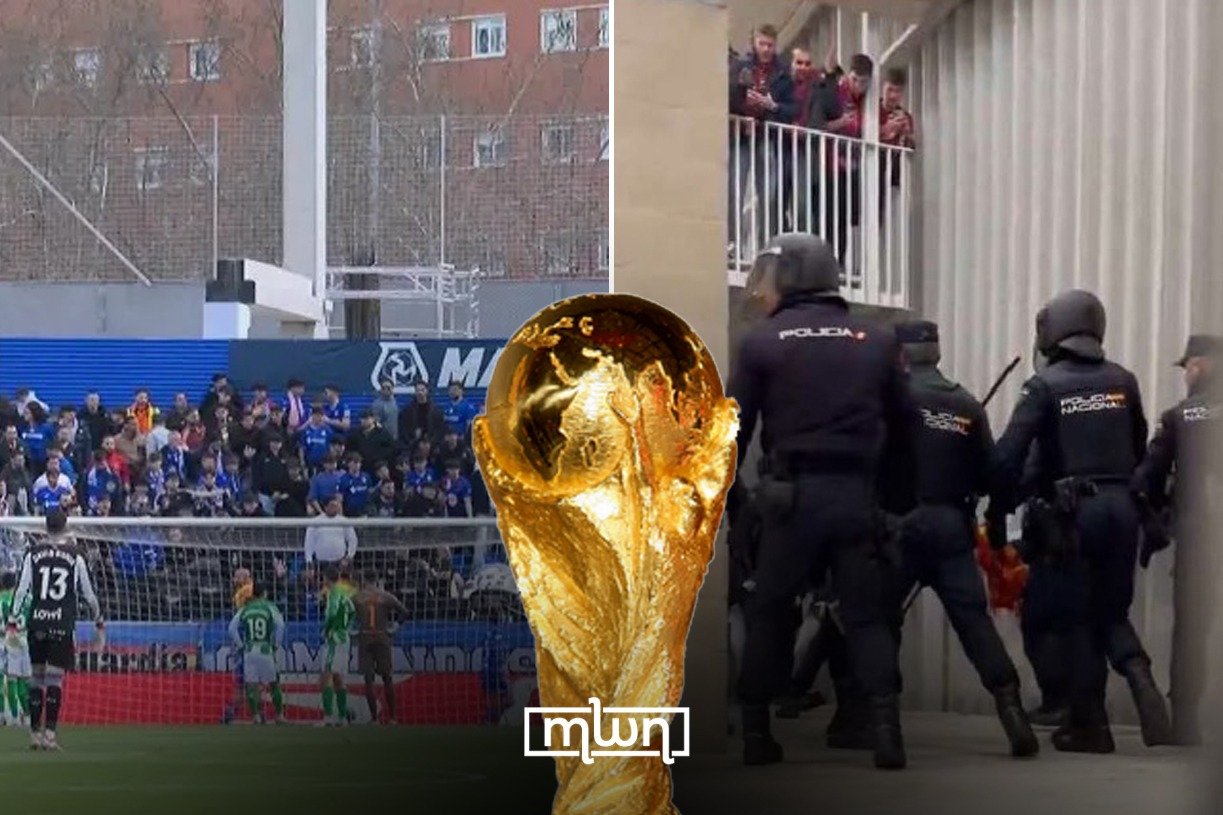
Rabat – Just weeks after controversial scenes in Pamplona that shocked football fans, another incident has unfolded in Spain, this time at the Coliseum Alfonso Perez, where police had to intervene during a league game between Getafe and Real Betis.
The match had barely begun when tensions escalated in the stands. At around the seventh minute, clashes broke out between groups of supporters behind one of the goals.
According to Spanish media reports, several Getafe ultras attempted to approach the section reserved for Betis fans, triggering chaos that forced security forces and police to step in.
The referee stopped the match for about five minutes while police intervened to separate the groups and restore order in the stadium.
La Liga later condemned the incidents and promised to cooperate with authorities to identify those responsible, reiterating its policy of “zero tolerance” for violence in stadiums.
Spain now faces fresh concerns over stadium security before it prepares to co-host the 2030 FIFA World Cup with Morocco and Portugal.
From Pamplona to Getafe, the pattern is hard to ignore
This was not an isolated case, in recent weeks, Spanish football has seen repeated crowd-control problems.
The most serious came in Pamplona, where police intervention after Osasuna’s win over Real Madrid led to baton charges and injuries in the stadium corridors.
At the Coliseum in Getafe, another La Liga match was disrupted by clashes in the stands that forced police to intervene.
These repeated incidents matter. Spain is preparing to co‑host the 2030 FIFA World Cup, and the tournament will bring the highest level of global security scrutiny.
Hosting the event is not only about stadiums, infrastructure, or broadcast reach. It is also – and perhaps more importantly – about proving that fans can gather in safe, controlled environments.
When matches are stopped because of supporter clashes, it raises doubts about crowd management.
The Getafe‑Betis game showed how quickly chants and movement in the stands can escalate into confrontation, requiring riot police and a play pause.
Even though order was restored, the image of another La Liga match interrupted by violence adds to a troubling pattern. For a World Cup host, the expectation is clear: prevent incidents before they escalate to confrontation.
To be sure, Spain is not the only country where tensions spill into the stands. Morocco has seen similar moments in its Botola league, with clashes between fans and security during heated matches.
But what frustrates many Moroccan observers is how these incidents are framed. When trouble happens in Morocco, some international and Spanish media show it as proof of institutionalized disorder or weak institutions. The story quickly becomes that Morocco struggles with stadium security.
But when similar scenes occur in Spain, they are often described as isolated events, unfortunate but temporary, not a reflection of the country’s ability to host major tournaments.
The truth is more balanced. Domestic leagues everywhere face crowd tensions, especially when ultras are involved.
The real test of security is not whether incidents happen, but how a country manages high‑pressure international events when the stakes are highest.
Racism is another warning sign Spain cannot ignore.
Security is not the only issue affecting Spain’s football image ahead of the 2030 World Cup. Racism remains a serious problem, with recent cases showing it has not gone away.
Last week, Espanyol’s Omar El Hilali accused Elche’s Rafa Mir of using a racist insult during a La Liga match.
The referee stopped play for three minutes under the anti‑racism protocol. Reports said the phrase used was “you came in a small migrant boat,” a loaded anti‑immigrant slur. The case is now with disciplinary bodies, though Mir denies the allegation.
This comes on top of repeated racist abuse directed at Real Madrid star Vinicius Junior inside Spanish stadiums over the past several seasons.
The most notorious case occurred in May 2023 at Valencia’s Mestalla stadium, where racist chants targeting the Brazilian forward forced the referee to temporarily stop the match.
The incident sparked global outrage and renewed scrutiny of racism in Spanish football.
In May 2025, Spanish courts handed suspended prison sentences to five Valladolid supporters for racially abusing Vinicius, a landmark ruling that confirmed racist abuse in stadiums can be prosecuted as a hate crime.
Spain is heading toward the 2030 World Cup with two clear problems: crowd‑control failures and racism.
Neither can be ignored. Morocco has had domestic crowd issues, but at AFCON, it showed it could manage tension and protect the tournament.
Spain, by contrast, is still struggling to come to terms with regular red flags – in the stands, in police interventions, and in racist incidents.
