


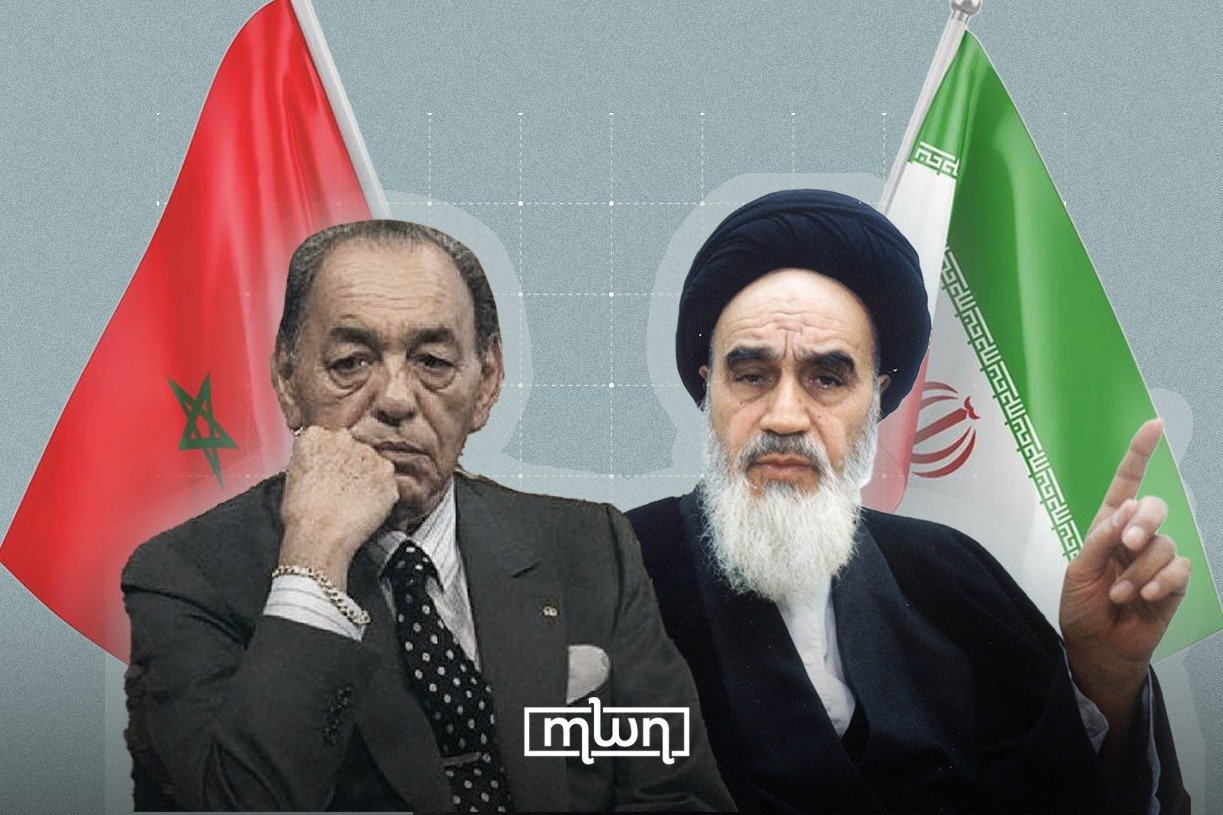
Marrakech – The assassination of Ayatollah Ali Khamenei on Saturday – the second man to hold the title of Supreme Leader of the Islamic Republic since 1989, and the inheritor of a theocratic order born in the fires of 1979 – by a joint US-Israeli military operation that shook Tehran to its foundations, has done more than eliminate a head of state.
It has reopened a chapter of history that the Islamic Republic would rather have kept buried: the chapter in which a Moroccan king, armed with nothing but theological authority and royal defiance, stood before the world and declared Ayatollah Ruhollah Khomeini – the founder of that very republic – a heretic, an apostate, and a fraud. That king was Hassan II of Morocco. And his war against the Iranian theocracy was not merely political. It was civilizational.
To understand the depth of Hassan II’s fury toward Khomeini, one must first understand what came before it – a friendship between two monarchies so intimate that it bordered on brotherhood. The Kingdom of Morocco and Imperial Iran under the Pahlavi dynasty shared a bond that was at once strategic and deeply personal. Both were pro-Western monarchies navigating the treacherous currents of the Cold War. Both saw themselves as custodians of ancient civilizations. And both ruling houses – the Alaouites and the Pahlavis – cultivated a relationship that went far beyond protocol.
The regime born in 1979 – unable to reflect a civilization shaped by Cyrus the Great, Darius, Ferdowsi, and Hafez – reduced Iran from the intellectual and imperial heart of Persia into a state internationally associated with uranium centrifuges at Natanz, Revolutionary Guard networks, and proxy militias stretching from Beirut to Sana’a, replacing centuries of cultural radiance with an export model built on revolution, sanctions, and perpetual confrontation.
Royal friendship shattered by revolution, exile, and enduring geopolitical revenge
The Shah Mohammad Reza Pahlavi visited Morocco in 1966, and King Hassan II returned the honour with a state visit to Tehran in 1968. That visit produced one of the most remarkable scenes in modern Middle Eastern diplomacy. The Shah, a man perpetually anxious about assassination, chose to ride with Hassan II in an open car through the streets of Tehran – something he had never done before.
Moroccan diplomats recalled the Shah telling the King: “I am entering Tehran for the first time in an open car… because I am in your company, and with you nothing will happen to me. I am beside a descendant of Ali and Fatima.” The crowds along the route reportedly chanted “Ya Ali, Ya Hussein” in reverence for the Moroccan monarch’s Sharifian lineage.
Between 1966 and 1974, the two kingdoms signed multiple cooperation agreements covering friendship, trade, education, and technical exchange. They also became founding members of the secretive Safari Club in 1975, a Cold War-era intelligence alliance that also included Saudi Arabia and France. The bond was strategic, personal, and unshakable – or so it seemed.
Then came 1979, and the world Hassan II had known collapsed overnight. Before the revolution’s triumph, Hassan II dispatched his advisor Abdelhadi Boutaleb to bridge and mediate between the Shah and Khomeini, but the tide of revolution had already rendered compromise impossible.
As the Shah’s regime crumbled under the weight of Khomeini’s revolution, Hassan II did not abandon his friend. When the Shah fled Iran on January 16, 1979, he stopped briefly in Egypt before flying to Morocco as a guest of the King. Hassan II housed the fallen emperor and his family in a villa in Marrakech, extending the kind of hospitality that only a fellow monarch could offer to a brother in exile.
It was a gesture that came at enormous cost. Graffiti appeared on the walls of Rabat reading “One Shah in Morocco is enough.” A French intelligence emissary reportedly arrived at the Royal Palace to warn that Khomeini had ordered the kidnapping of members of the Moroccan royal family in exchange for the Shah. Hassan II held firm. But the new revolutionary regime in Tehran had taken note – and it would not forget.
What followed was a rupture so complete that it would define Morocco-Iran relations for nearly half a century. In 1980, the Islamic Republic recognized the so-called “Sahrawi Arab Democratic Republic” (SADR) declared by the Algerian-backed separatist Polisario Front – a direct assault on Morocco’s territorial integrity and a calculated act of revenge for sheltering the Shah. Morocco severed diplomatic relations in 1981. But Hassan II was only getting started.
‘If Khomeini is Muslim, then I am not’
In 1982, the King convened Morocco’s Supreme Council of Ulema – the highest religious authority in the kingdom – and the council issued a fatwa (decree) labeling Ayatollah Khomeini a heretic and an apostate. This was no casual political insult. Takfir is the formal act of declaring a Muslim to be a kafir – an unbeliever, someone who has placed themselves outside the fold of Islam entirely. It is not name-calling. In Islamic jurisprudence, takfir is among the gravest pronouncements that can be issued, because it severs the person from the community of believers altogether.
Mainstream Sunni scholars have historically treated it with extreme caution, warning that to wrongly accuse a fellow Muslim of unbelief is itself a grave sin. For a head of state who also held the title of Commander of the Faithful – a direct descendant of the Prophet Muhammad – to convene his kingdom’s highest religious body and direct them to issue takfir against the leader of another Muslim nation, who claimed to speak for all Muslims, was, in the modern era, virtually without precedent. It was a theological nuclear strike.
Hassan II himself did not mince words. In an interview with the French newspaper Le Figaro, he described Khomeini as a “deviant heretic,” and the phrase that would echo through history was attributed to him in various forms: “If Khomeini is Muslim, then I am not.” It was a theological declaration of war – one monarch’s faith against another’s revolution.
Protests across the nation, and a targeted culprit
The hostilities deepened dramatically in January 1984, in the context of what Moroccans would come to call the Bread Uprising – an explosion of popular anger that erupted on January 19 across the kingdom’s northern cities and beyond. The immediate triggers were brutally material: a sharp increase in food prices, a hike in student fees, and the grinding consequences of a structural adjustment programme imposed by the International Monetary Fund (IMF) that had squeezed the life out of working-class households for two years running.
What began as student demonstrations in Al Hoceima, Nador, Tetouan, and Ksar el-Kebir – students whom King Hassan II later accused of being pushed to the front lines by ideological agitators and political factions – rapidly swelled into a nationwide eruption as workers, the unemployed, and the urban poor joined the marches. Marrakech burned. The army was deployed. By the time the regime restored order, some two hundred Moroccans lay dead, and the kingdom’s streets were quiet only because they had been emptied by force.
It was in this atmosphere of crisis that Hassan II delivered what would become one of the most consequential speeches of his reign – the royal address of January 22, 1984. The King did not deny the economic suffering. But he was not interested in discussing bread prices that evening. He had come before his people to name the real enemy, and to read aloud the evidence of foreign hands reaching into Morocco’s wounds.
He began by reiterating, with the full weight of his authority as Commander of the Faithful, exactly why Morocco had declared takfir against Khomeini. The issue, he explained, was not political disagreement – it was theological abomination. The Supreme Leader and his followers subscribed to the doctrine of the Imamate: the belief that a divinely guided Imam, descended from the Prophet’s son-in-law Ali, holds supreme spiritual and temporal authority over all Muslims, and that the Twelfth Imam – known as the Mahdi – had gone into occultation centuries ago and would one day return to establish justice on earth. In itself, this was an old Shia doctrine that Sunni scholars had debated for a millennium.
But what made Khomeini’s version intolerable to Hassan II – and to Morocco’s ulema – was the claim, rooted in certain strands of Shia theology, that the Imam occupies a station of closeness to God that surpasses that of the angels, the prophets, and the messengers – including the Prophet Muhammad himself. For a Sunni Muslim, and above all for a king whose entire legitimacy rested on his descent from Muhammad and his role as guardian of the Prophet’s tradition, this was not heterodoxy. It was blasphemy.
It was the elevation of a hidden, absent figure above the Seal of the Prophets – and it was the theological foundation upon which Khomeini had built his claim to rule. That, Hassan II reminded his nation, was why Morocco’s Supreme Council of Ulema had issued the fatwa of takfir. Not out of political spite, but because Khomeini’s doctrine placed itself, in the eyes of Sunni jurisprudence, outside the boundaries of Islam altogether.
Then the King did something remarkable. He began reading aloud from seized documents – pamphlets and tracts that had been circulating in Moroccan cities in the days and weeks before the uprising. The first was from Ila al-Amam, a clandestine Leninist-Marxist organisation that the King identified by name with undisguised contempt. He read their words to the nation so that every Moroccan could hear what was being whispered in the shadows: “Let it be known to us that our current bitter situation is the result of the Sahara war that the defeated monarchical regime is waging against the heroic Sahrawi people, a war in which thousands of our sons are being sacrificed – and it is not the result of drought, as Hassan the Bloodshedder claims.” The King paused, looked up, and said with the calm of a man who had survived two assassination attempts and buried the fear of a third: “I read everything. This does not frighten me.”
He was not finished. He then produced a second document – a pamphlet distributed by Khomeini’s sympathisers, carrying the words of the Ayatollah himself, aimed squarely at the Organisation of Islamic Cooperation (OIC) summit that had recently convened. Hassan II read Khomeini’s message in full: “In these fateful days through which the Islamic world is passing, living through a difficult labour, people who claim to represent Islamic peoples gather and call their assembly the Islamic Summit Conference – when it would be more fitting to call it the Conference of Jahili Conspiracy. These are the rulers who have imposed themselves upon the necks of our Islamic peoples, and hardly one among them is free from servitude to one of the two Great Satans – America and Russia.”
The King let the words hang in the air. Then he delivered his verdict: all of this – the pamphlets, the incitement, the leaflets calling for his overthrow – was the work of foreign hands exploiting genuine hardship to manufacture chaos. Iran’s revolutionary apparatus, working in concert with radical leftist cells, was attempting to engineer unrest inside Morocco by riding the wave of legitimate economic grievance.
He called the agitators “rabble” and declared, in his characteristically defiant Moroccan Darija: “As long as I continue to act within legitimacy,” he said, those who had called on him to step down would see “their father’s house brought down.”
He then warned that Iran’s revolutionary export project would find no fertile ground in Morocco. The King’s position was unambiguous: Iran was not an Islamic ally but an ideological enemy, and Khomeini’s version of Islam was a perversion that the Kingdom of Morocco, guardian of the Maliki Sunni tradition and seat of the Commandership of the Faithful, rejected absolutely. The 1984 uprising had been crushed with bullets and curfews. But Hassan II understood that the deeper war – the war for Morocco’s soul – would be fought with fatwas, speeches, and the unflinching assertion that the Commander of the Faithful would bow to no Ayatollah.
Hassan II confronts revolutionary Iran’s ideological, political, and proxy expansion
Hassan II apprehended the Iranian threat on multiple levels. Theologically, Khomeini’s doctrine of Wilayat al-Faqih – the Guardianship of the Islamic Jurist – was a direct challenge to the Moroccan model of Imarat al-Mu’minin, the Commandership of the Faithful. Where the Moroccan king derived religious authority from prophetic lineage and Sunni scholarly consensus, Khomeini claimed it through Shia jurisprudential theory. These were not merely different interpretations of governance – they were competing claims to Islamic legitimacy itself.
The King also grasped the political dimension. The Iranian Revolution had inspired Islamist movements across the Arab world, and Morocco was not immune. His fears about the revolution’s contagion – that it would not remain confined to Tehran – were not paranoid fantasies, but assessments grounded in developments already unfolding within his own kingdom. Nearly every major Islamist movement in Morocco had, in one way or another, been electrified by the Iranian revolution. Apart from Salafi movements, virtually all Islamist currents in Morocco were influenced by Khomeini’s triumph. The many factions that had splintered from Chabiba al-Islamiya (Islamic Youth) saw in the Iranian model a call to reunite and strengthen their organizational capacity to confront the future “the Iranian way.”
More radical elements went further, founding Al Ikhtiar al-Islami (Islamic Choice), which drew directly from Iran’s political theses rather than from Shia theology per se. And then there was Sheikh Abdessalam Yassine, whose Al-Adl wal-Ihsan (Justice and Charity) movement – though it would not formally bear that name until 1987 – was deeply shaped by the Iranian moment. Yassine’s early publications openly explained Khomeini’s concept of Islamic government, and his central idea of al-Qawma (a religiously grounded uprising or corrective rise against unjust rule) was essentially the mirror image of the Supreme Leader’s revolution. For Hassan II, this was not an academic concern. It was a live threat unfolding within his borders.
And the danger of this ideology extended far beyond theology. What made the Iranian model uniquely corrosive was its marriage of revolutionary politics with religious authority, and its deliberate strategy of projecting power through proxy warfare rather than conventional diplomacy. Tehran did not merely disagree with its neighbours – it sought to hollow them out from within. Hezbollah in Lebanon, the Houthis in Yemen, Shia militias in Iraq, and networks of influence stretching from Bahrain to West Africa – all were instruments of a single doctrine: that Iran’s Supreme Leader was the rightful guardian of all Muslims, and that any state that rejected this premise was a legitimate target for subversion. This was not the behaviour of a nation-state. It was the behaviour of a revolutionary movement wearing the mask of one.
During the Iran-Iraq War, Morocco firmly sided with Baghdad. At the 1982 Arab Summit in Fez, Hassan II stressed Morocco’s obligation to support Iraq under the Arab Collective Defense Treaty. Iran and Syria later attempted to suspend Morocco’s membership in the Organisation of Islamic Cooperation (OIC) after Hassan II met with Israeli Prime Minister Shimon Peres in 1986, but Moroccan diplomacy successfully blocked the motion. The King was fighting on every front – against Khomeini’s ideology at home, against Iran’s allies in international forums, and against Tehran’s proxies on the question of the Sahara.
The ice began to thaw, but Iran never truly left 1979 behind
It was only after Khomeini’s death in 1989 and the end of the Iran-Iraq War that the ice began, cautiously, to thaw. Iranian diplomats approached Rabat by invoking shared religious heritage, reportedly telling Moroccan officials: “Do you know the blood ties that unite our countries, ruled by a King descended from Ali?” Diplomatic relations were formally restored in 1991 on the sidelines of the OIC summit in Dakar. But the scars ran deep, and trust was never fully rebuilt.
Under King Mohammed VI, Morocco attempted a policy of cautious engagement with Tehran. Prime Minister Abderrahman Youssoufi visited Iran in 2001. Relations improved tentatively during the 2000s. A telling moment of symbolic deference unfolded during the 1997 Islamic Summit in Tehran, when Moroccan delegates alone were exempted from the customary protocol of removing their shoes before meeting Khamenei – a distinction he later justified, declaring: “Your king is a descendant of Ali, and thus holds a special place among us.”
But Tehran’s ambitions had not changed – only its methods. In 2009, Morocco severed ties again after an Iranian official described Bahrain as “the fourteenth Iranian province” and amid mounting evidence of Iranian proselytization efforts to spread Shiism inside Morocco itself – a campaign Rabat viewed as an existential threat to the kingdom’s religious identity. A brief reconciliation followed the 2015 nuclear deal, but it was short-lived.
This would later push Morocco to intensify its religious diplomacy across Africa, culminating in the 2015 establishment of the Mohammed VI Foundation of African Ulema, institutionalizing Rabat’s effort to promote Maliki-Sunni Islam as a strategic counterweight to revolutionary and sectarian influence.
The final and most dramatic break came in May 2018, when Foreign Minister Nasser Bourita traveled to Tehran to personally deliver a dossier of evidence to his Iranian counterpart. The evidence, Bourita told the world, proved that Hezbollah – acting with the support of the Iranian embassy in Algiers – had been training and arming the Polisario Front. The charges were devastating in their specificity: Hezbollah had transferred surface-to-air missiles, including SAM-9, SAM-11, and Strela systems to the Polisario, and had provided training in urban warfare techniques in the Tindouf camps. Iran’s cultural attaché in Algiers had facilitated the entire operation. Morocco closed its embassy in Tehran and expelled the Iranian chargé d’affaires with immediate effect. The Arab League and the Gulf states rallied behind Rabat. Hassan II’s ghost, it seemed, had been vindicated.
Now, with Khamenei’s body pulled from the rubble of a US-Israeli strike – the longest-serving leader of the Islamic Republic reduced to a casualty of the very confrontation his regime had spent decades provoking – the arc of this story feels strangely complete. The theocratic order that Khomeini built and Khamenei sustained for 37 years now faces its most existential crisis. A provisional leadership council scrambles to hold power in Tehran. The IRGC launches retaliatory strikes across the Gulf.
And in Rabat, Morocco’s Ministry of Foreign Affairs has issued a statement condemning Iran’s missile attacks on five Arab Gulf states as a “flagrant violation of national sovereignty,” declaring “full solidarity” with the targeted nations. King Mohammed VI personally reinforced that position during calls with Gulf leaders, stressing that the security and stability of the Arab Gulf states are inseparable from Morocco’s own security, and condemning the attacks as a serious and unacceptable aggression.
Hassan II died in 1999, a quarter century before this moment. But, the framework he established – that Iran’s revolutionary project was a threat not only to Morocco but to the entire Sunni Arab order; that Khomeini’s revolution was a deviation from Islam, not an expression of it; that the Commandership of the Faithful must stand as a bulwark against the Guardianship of the Jurist – remains the foundation of Moroccan foreign policy toward Tehran.
He was the first Arab leader to issue a formal fatwa of takfir against the founder of the Islamic Republic. He was the first to publicly name the Iranian revolution as a source of terrorism. And he did so not from a position of sectarian hatred, but from the conviction of a man who believed, with every fiber of his being, that his Islam and Khomeini’s Islam were not the same religion. History, it seems, chose its side.
Read also: Should Moroccans Celebrate the Fall of Iran’s Theocratic Regime, Venezuela’s Maduro?
