


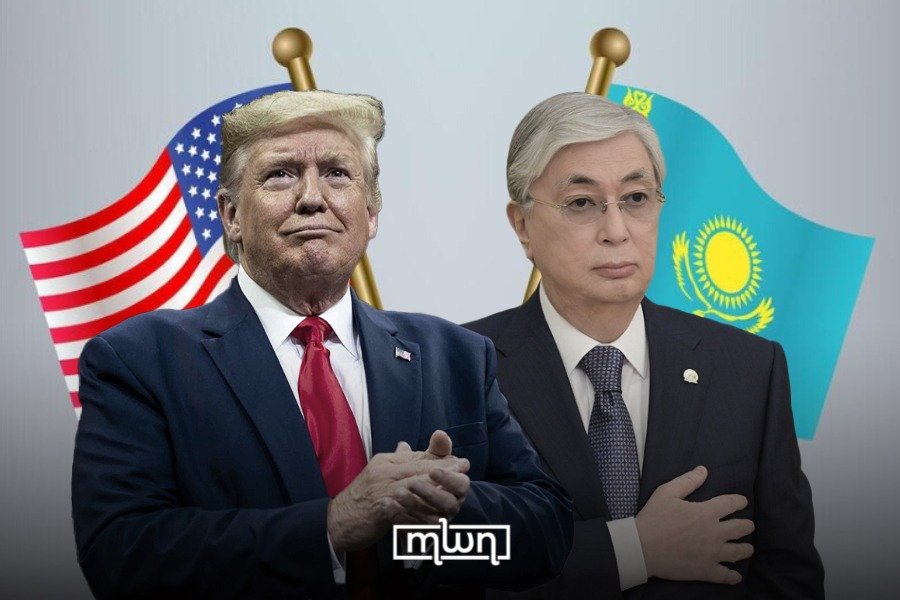
Rabat – In what reads like an impassioned plea for further cementing relations with theTrump’ administration, Kazakhstan’s President Tokayev touted last week in the American magazine “The National Interest” his country’s strong relationship with the US, arguing that globalism needs a revamp and that US President Donald Trump is leading this cause.
The Trump White House is treating peace as a project, not just a slogan, the article suggested. It then refers to the Board of Peace under Trump’s leadership as a “truly innovative approach,” asserting that through “its novelty and ambition, the initiative deserves respect and international attention.”
Kazakhstan was the first country of Trump’s second term to join the Abraham Accords, and as a member of the Board of Peace committed troops to the Gaza International Stabilization Force (ISF) last week, along with five other nations, including Morocco.
The heart of US-Kazakhstan relations
Tokayev describes his country’s membership on the Board of Peace as a “logical continuation of Kazakhstan’s decision to join the Abraham Accords.” He maintains simultaneous support for Israel and the Palestinian people, advocating for a two-state solution – a notion the Abraham Accords completely bypasses.
The article then reaches the heart of the US-Kazakhstan partnership: capital. “American companies have long been among Kazakhstan’s largest investors, particularly in the energy sector,” Tokayev writes.
“Kazakhstan remains firmly committed to being a reliable and honest partner that prioritizes stability, respects international obligations, and delivers tangible results.”
These tangible results include a $7 billion procurement in Boeing 787-9 aircraft to build Air Astana’s fleet, $4.2 billion in orders for US locomotives, and $3.7 billion in partnerships between Kazakhstan’s Ministry of Artificial Intelligence and Digital Development and U.S. technology companies including HP, Oracle, and Starlink.
Tokayev lists Kazakhstan’s achievements of integrating into global markets, digital transformations, and a GDP per capita of $15,000, making it the largest economy in Central Asia.
“Our ambition is clear: to become a major transit and logistics corridor connecting Asia and Europe, while simultaneously building a modern economy grounded in technology, innovation, and human capital,” he writes.
Controversial reforms at home
Institutional reforms are also necessary for economic progress, the president declares, arguing that Kazakhstan is “moving beyond a super-presidential model toward a governance system based on stronger checks and balances, guided by the principle of a “Strong President, Influential Parliament, and Accountable Government.’”
As the country prepares to hold a referendum in March to vote on a new constitution, Tokayev believes that this constitutional reform aims to “strengthen public institutions, enhance accountability and ensure more sustainable and resilient governance for the future.”
Despite the president’s affirmations, there has been significant public backlash to the proposed changes to Kazakhstan’s constitution. Over 60 legal experts, human rights defenders, and activists wrote an open appeal to Tokayev expressing their concern over the rushed and vague changes, which could violate international human rights laws.
The changes omit the right to strike and removes reference to international law taking precedence over domestic law. It also requires nongovernmental organizations to disclose any foreign funding, and no longer requires Senate approval for the country’s Human Rights Commissioner, who is appointed by Tokayev.
Several lawyers, journalists, and citizens have been arrested, fined, or generally intimidated by the police over their public criticism of the constitutional reforms in recent weeks. This has created a “climate of fear and self-censorship,” “undermining open public discussion and access to information,” according to Human Rights Watch.
“Genuine constitutional reform should strengthen rights protections and be shaped through an open and transparent process – not used to concentrate power or silence dissent,” said Mihra Rittmann, Central Asia adviser at Human Rights Watch.
In response, Government officials have suggested that the changes to nearly 80% of the current constitution are necessary to ensure “law and order.”
Tokayev echoes this line throughout the article. “The world is not moving away from cooperation. It is moving away from illusion,” he writes. The new emerging doctrine is straightforward: order must be based on the rule of law, responsibility, predictable commitments, and respect for cultural and national identity. This is not isolationism. It is political maturity.”
Kazakhstan’s increasingly tight alliance with the US and criticism for “governments associated with left-leaning ideological agendas” creates a clearer image of what this “political maturity” looks like, as we see more previously overlooked countries play ball in order to take a place on the international stage.
Read Also:Morocco is Officially Among the First Five Countries to Commit troops to Gaza’s ISF
The post President Kassym-Jomart Tokayev on US Ties: ‘Reliability is the New Power’ appeared first on Morocco World News.
