


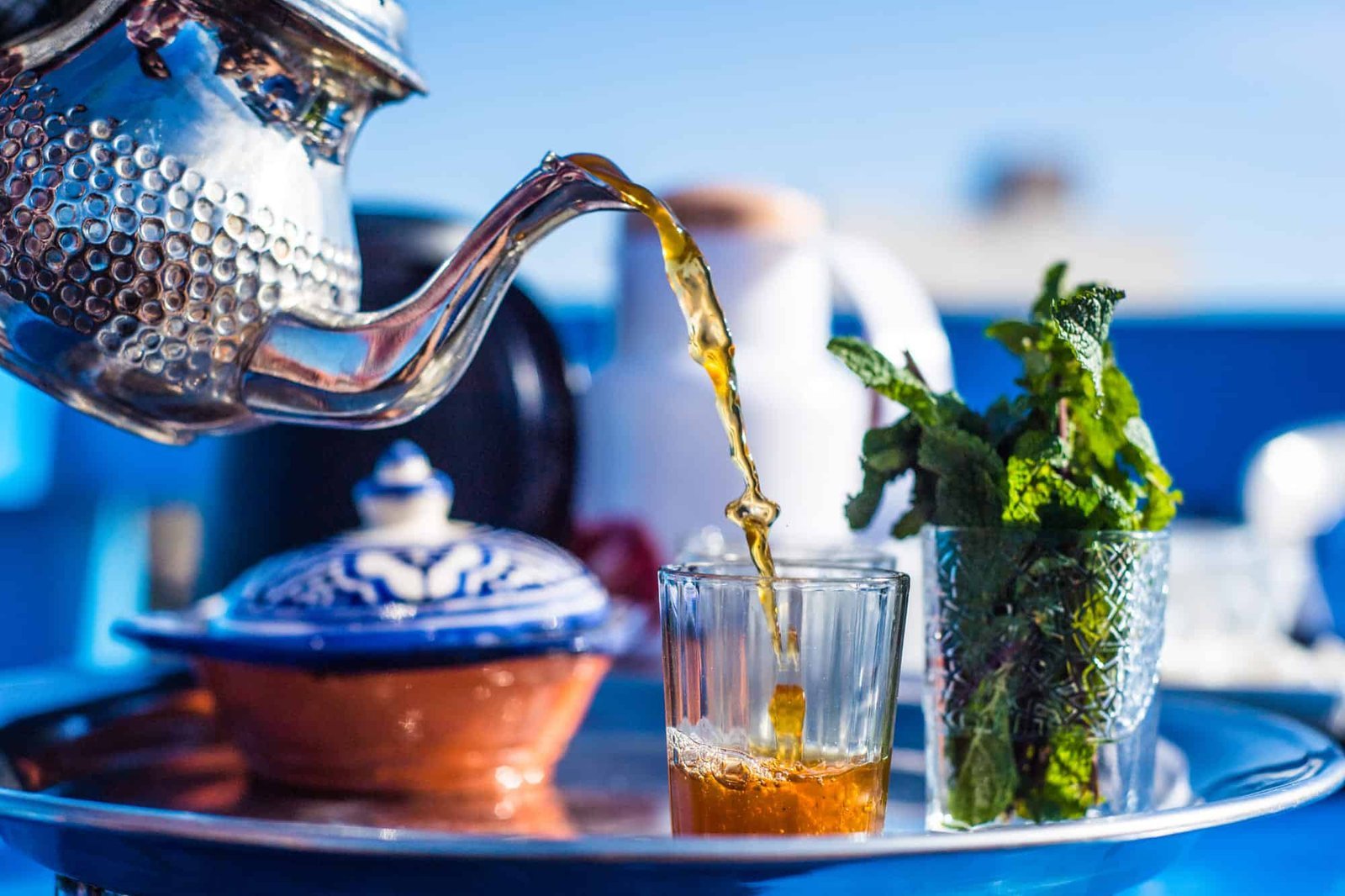
When I first arrived in Morocco back in 2013, I remember sitting in a local family’s living room, slightly bewildered (as usual), watching the head of the household pour tea from what seemed like an impossibly high angle into tiny, ornate glasses. The amber liquid cascaded down, forming a perfect crown of foam on top. Everyone watched. Nobody rushed. And right there, in that unhurried moment, I understood something essential about Morocco: tea isn’t just a drink here — it’s a language.
Moroccans call it “atay” (أتاي), and trust me when I say it is everywhere. Morning, afternoon, evening, late at night — there is never a wrong time for atay. It flows through Moroccan life the way conversation flows through a gathering: naturally, generously, endlessly.
But here’s what fascinated me most — this deeply Moroccan tradition? It actually started with the British.
A Royal Beginning: How Tea Came to Morocco
According to the book “From Tea to Atay” (Min Al-Shay Ila Al-Atay) by Abdelahad Sebti and Abderrahman Lakhsassi, Moroccans were first introduced to tea through Britain at the beginning of the 18th century, during the reign of Sultan Moulay Ismail.
Back then, tea was incredibly rare. It was initially used as medicine — not sipped for pleasure — and was exclusively reserved for the Makhzen, the inner circle of the Sultan’s court. European diplomats would present it as a precious gift to the Sultan and his entourage. For an entire century, tea remained a luxury that only the elite could dream of tasting.
Imagine that! The drink that today flows freely in every home, café, and roadside stall across Morocco was once a symbol of royalty and privilege.
But as the decades rolled on, something beautiful happened. By the early 20th century, atay had broken free from palace walls. It transformed from a nobles-only indulgence into the undisputed national drink of Morocco — embraced by every social class, in every corner of the country.
More Than a Drink: Tea as the Heart of Moroccan Hospitality
One thing I learned very quickly living here: if you visit a Moroccan home and leave without drinking tea, something has gone terribly wrong.
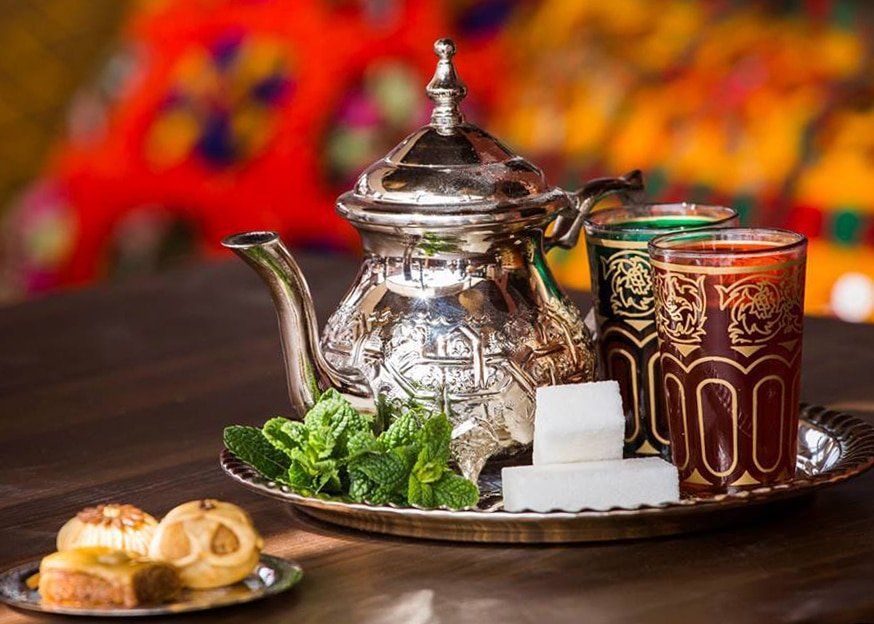
In Moroccan culture, it’s considered genuinely rude — a serious lack of etiquette — for a guest to leave without being offered (and drinking) at least one glass of atay, usually accompanied by some cookies or pastries. Tea is the ultimate gesture of welcome, warmth, and respect.
And here’s a little cultural detail I absolutely love: when a family prepares the tea tray for guests, they deliberately place more glasses than the number of people present. It’s a subtle but powerful message — “You are welcome here, and there is always room for more.” Extra glasses signal generosity and open-heartedness.
But — and this is the part that made my eyes widen when I first learned it — if the hostess sets out only the exact number of glasses (or fewer), it can be a quiet, indirect way of saying, “This isn’t the best time for a visit.” No words needed. The tea tray speaks for itself. Moroccan communication at its finest!
The Magical Herbs: It’s Not Just Mint
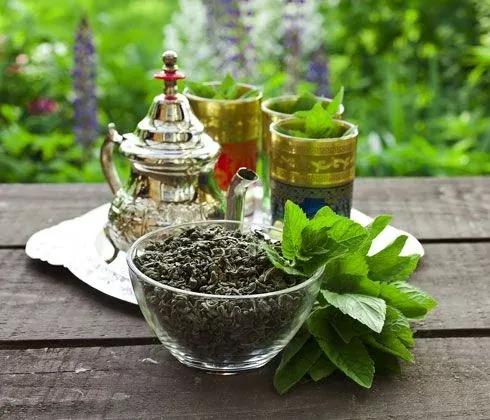
When most people think of Moroccan tea, they picture mint. And yes, fresh spearmint (na’na’) is the classic star of the show, especially during the hot summer months when its cooling, refreshing flavor is pure bliss.
But what surprised me is that Moroccans are incredibly creative and intentional about which herbs go into their tea, often guided by the season and even their physical wellbeing.
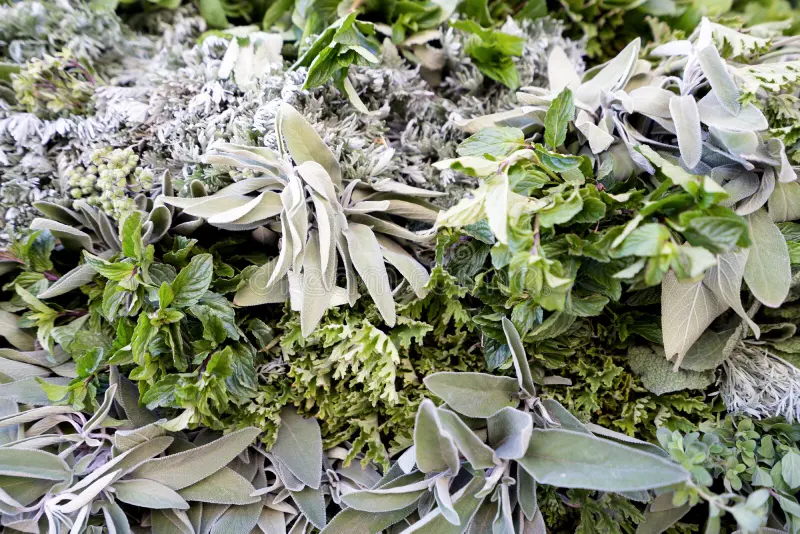
In winter, you’ll find tea made with louiza (lemon verbena) or shiba (wormwood/absinthe plant). Both are known for their warming properties — they help raise body temperature, promote relaxation, and make it easier to drift off to sleep on cold Moroccan nights.
In spring, some regions add orange blossom flowers (zhar) to their tea, giving it the most delicate, floral aroma you can imagine.
In summer, it’s all about the classic fresh mint — nothing beats that burst of cool freshness when the temperatures climb.
When someone is sick — fighting a cold or seasonal illness — the tea transforms into something almost medicinal. Families will add thyme (za’atar) and anise (yansoun) to the brew, turning that daily glass into a healing, soothing remedy.
I find this absolutely beautiful — the way Moroccans have woven nature’s pharmacy right into their most cherished daily ritual.
The Art of Preparation: Watching the “Mqim” at Work
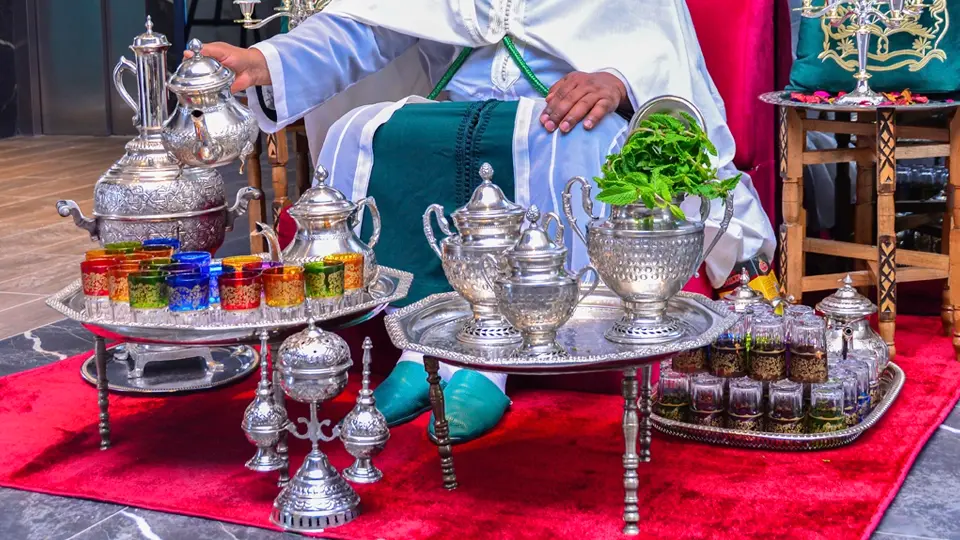
If there’s one thing I want you to understand about Moroccan tea, it’s this: preparation is not a behind-the-scenes affair. In Morocco, tea must be prepared in front of the guests. Doing it in the kitchen and just bringing out a ready tray? That would be considered a lack of respect.
The person who prepares the tea is called the “mqim” (مقيم), and it’s usually the head of the household. For special occasions, the role goes to the eldest person present or someone known for their tea-making skills. It’s a position of honor.
Here’s what the ritual looks like — and I never get tired of watching it:
The tea tray (siniya) is brought out, beautifully set with the teapot (berrad), glasses, sugar, tea leaves, and fresh herbs. The tray and teapot are traditionally made of silver or a similar metal, depending on the family’s means. A small silver basin is even brought for the mqim to wash their hands before starting — every detail matters.
The mqim takes a practiced handful of green tea leaves (Chinese gunpowder tea is the standard) and places them in the teapot. A small amount of boiling water is poured in, swished around to wash the leaves and reduce bitterness, then discarded into a glass. Sugar and fresh herbs are added, the pot is filled with boiling water, and it goes on the fire to simmer.
Then comes my favorite part: the tasting and balancing. The mqim pours a small amount, tastes it, adjusts the sweetness, then pours three or four glasses and pours them back into the pot. This back-and-forth mixing ensures that every single glass will taste exactly the same — perfectly balanced.
The Pour: Where Tea Becomes Art
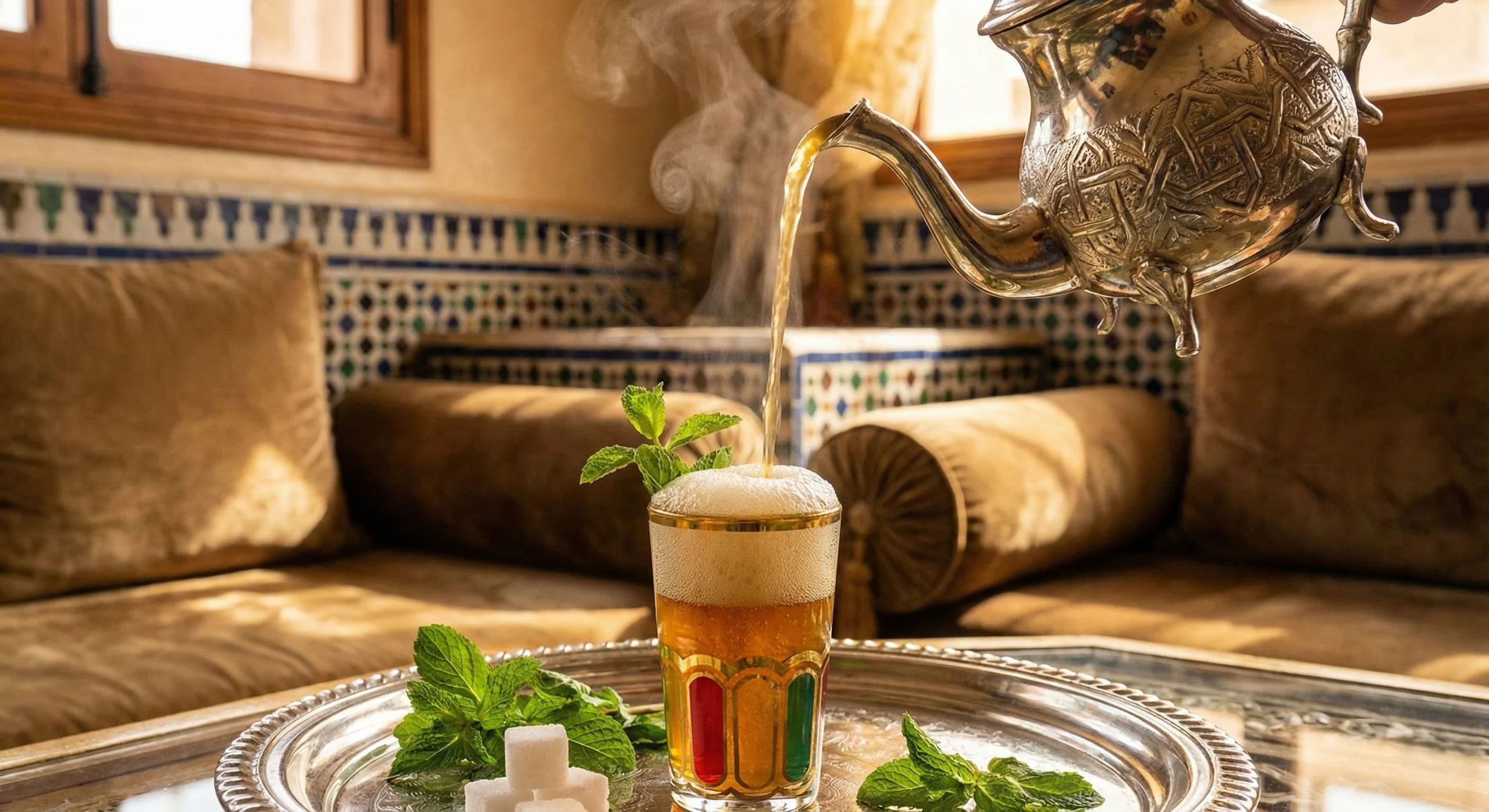
And then — the grand finale. The mqim lifts the teapot high above the glasses and pours in one graceful, continuous motion. The tea arcs through the air and lands in the glass, creating a beautiful layer of foam (rghwa) that fills about a quarter of the glass.
In traditional Moroccan custom, the quality of the tea — and the skill of the mqim — is judged by the amount of foam on top. More foam means better tea. It’s essentially the Moroccan equivalent of a barista’s latte art, except this tradition is centuries old.
Once all the glasses are poured, they’re distributed to the guests, and that first sip… sweet, minty, warm, slightly smoky from the gunpowder tea — it’s one of life’s simple, perfect pleasures.
What Atay Has Taught Me
After over a decade of living in Morocco, I’ve come to see atay as so much more than a beverage. It’s a pause button in a busy day. It’s an invitation to sit, to talk, to connect. It’s how strangers become friends and how families stay close.
In a world that’s always rushing, Morocco’s tea culture is a gentle, persistent reminder that some of life’s most meaningful moments happen when you simply slow down, pour a glass, and share it with someone.
So the next time someone offers you a glass of Moroccan mint tea, say yes. Sit down. Watch the foam rise in your glass. And let yourself be — just for a moment — beautifully bewildered.
Have you ever experienced a Moroccan tea ceremony? What was your first impression? I’d love to hear your stories — drop a comment below or send me a message!
