


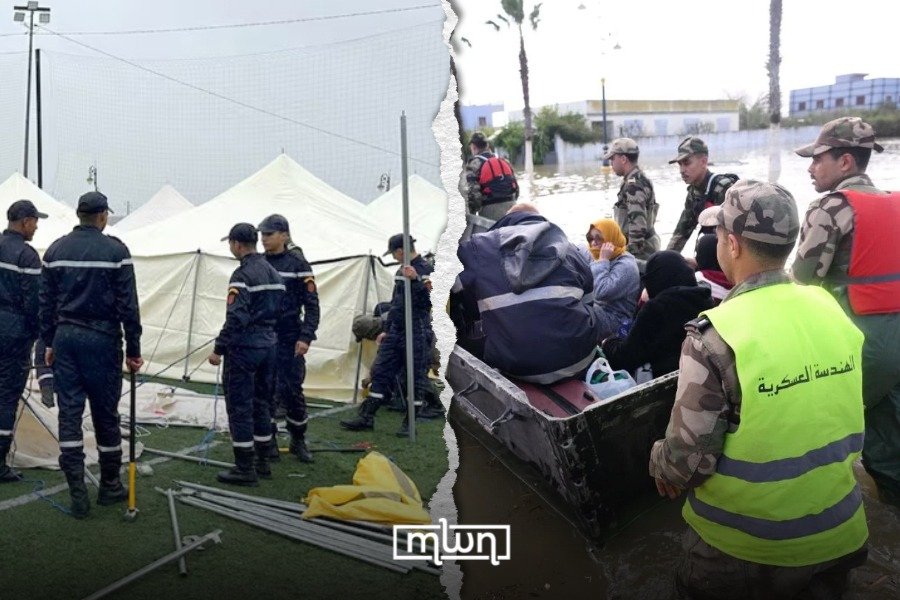
The torrential rains that have battered northern Morocco for several weeks are not a mere episode of intense weather. They amount to an exceptional hydrological shock whose cumulative effects simultaneously strained productive territories, major river basins, critical infrastructure, and entire populations. Before drawing political lessons, the facts must first be recalled.
Since the beginning of the hydrological season, rainfall recorded in the north of the country has far exceeded climatic norms. In Tangier, cumulative precipitation surpassed 1,500 mm between September 2025 and February 2026—three to four times the annual average. In the Loukkos and Sebou basins, in Chefchaouen, Kenitra, and Tetouan, similarly abnormal volumes saturated soils and river systems. In February, two successive storms worsened the situation, dumping in a matter of days the equivalent of several months of rainfall onto already waterlogged territories. Major dams, notably Oued El Makhazine and Al Wahda, reached critical thresholds, forcing controlled releases to prevent structural failure.
This combination—exceptional upstream rainfall and massive downstream releases—triggered major flooding in the Loukkos and Gharb plains. Cities such as Ksar El Kebir, Sidi Kacem, and Sidi Slimane were partially submerged. The Sebou River, constrained by topography and the saturation of hydraulic networks, was unable to absorb simultaneously both natural inflows and dam releases. This was not a localized flood event, but a systemic disruption of the functioning of a strategic territorial system.
The human scale of the crisis was considerable. Authorities organized preventive and successive evacuations involving, in total, between 140,000 and 190,000 people, according to consolidated assessments. Entire neighborhoods were temporarily emptied, with priority given to vulnerable families. Livestock was also relocated, and livelihoods protected to limit economic and social losses. More than 110,000 hectares of agricultural land were submerged, disrupting key cereal and market-gardening value chains. Roads were cut, irrigation networks overwhelmed, and essential services—drinking water and electricity—temporarily disrupted.
The institutional response matched the systemic shock. The most affected areas were declared disaster zones, triggering emergency legal and financial mechanisms. Under high royal instructions, the Royal Armed Forces were fully mobilized. Their logistical deployment capacity, civil engineering expertise, and medical support formed the operational backbone of the response. Civil protection, territorial authorities, and state services operated within an integrated command framework, ensuring evacuations, rescues, sheltering, aid distribution, and the securing of high-risk areas. Structured temporary camps hosted tens of thousands of displaced persons, with access to water, sanitation, and healthcare.
In parallel, a national emergency, recovery, and reconstruction plan—amounting to several billion dirhams—was launched to rehabilitate infrastructure, rebuild housing, support farmers, and provide direct assistance to affected households. Targeted compensation schemes were set up for impacted families, and local commissions assessed damages to ensure fairness in implementation. The State did not merely manage the emergency; it planned the phased return of populations, conditional upon strict safety criteria and the restoration of essential services.
Taken separately, these facts describe a large-scale crisis response. Taken together, they reveal something more: a demonstration of state capacity rarely acknowledged as such. What distinguishes this sequence is not only the scale of resources mobilized, but the coherence of the governance architecture deployed. Evacuations were preventive, initiated before the most destructive hydrological peaks. Command was clear, vertical, and legible from the center down to territorial levels. The response was not outsourced to international actors: it was endogenous, assumed, and sovereign. Security forces served as the backbone of public action—not as instruments of coercion, but as infrastructures of protection.
Above all, logistics became an instrument of public power. Moving civilian populations is more complex than deploying troops: it meant simultaneously evacuating, sheltering, feeding, providing medical care, protecting property, preserving livelihoods, and restoring essential services. Four fronts were managed at once: human security, territorial continuity (roads, water, electricity), economic continuity (agriculture, markets, supply chains), and psychological continuity (reassuring populations, preventing panic, maintaining trust). Few states, including among the wealthiest, manage to coordinate these dimensions simultaneously at national scale under acute climatic stress.
The shift was silent, but no less striking. There were no images of state collapse, no prolonged chaos, no durable humanitarian vacuum. This very absence of chaos is, in itself, a major political performance. Moving more than 100,000 people without catastrophe is no ordinary feat: it is the equivalent of temporarily relocating a medium-sized city. Whoever can move, feed, shelter, and protect populations passes the test of governance. The State did not lose territorial control during the crisis; it exercised sovereignty through protection, not coercion.
This episode therefore deserves to be elevated to the status of a strategic lesson. It sketches a Moroccan model of governance under extreme conditions, where strategic centralization is “cascaded” into effective territorial execution; where infrastructure is conceived as a component of national security; and where resilience and development are understood as security policies in their own right. In the age of climate shocks, disasters are no longer “accidents”: they are structural tests. States will be judged on their capacity to anticipate, evacuate, provide logistics, and rebuild.
In the era of climatic shocks, sovereignty is no longer proclaimed—it is proven. By protecting, relocating, and rebuilding, the Moroccan State governed. This response deserves to be studied, not ignored—not as a miracle, but as a model of governance under extreme conditions. Its greatest success is that it appeared ordinary. Yet relocating a city to save it never is. That is the signature of a state that works.
