



Rabat – Education leaders from across North Africa, the US, and the Mediterranean region gathered in Tangier on Thursday to exchange ideas and collaboratively address current challenges and innovations in international education programs. They also discussed how Morocco can strengthen support for international students and expand its role in global education.
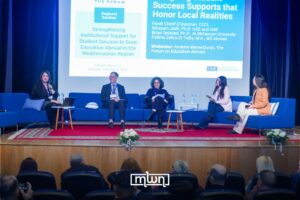
The one-day regional seminar, titled “Strengthening Institutional Support for Student Success to Grow Education Abroad in the Mediterranean Region,” was hosted by the Forum on Education Abroad in collaboration with the University of New England (UNE). It brought together university administrators, faculty members, and education practitioners working in study abroad and international exchange programs.
Held at UNE’s Tangier campus, the event focused on how institutions can better support foreign students, adapt programs to changing student needs, and build partnerships that go beyond traditional study abroad models.
While many sessions addressed practical challenges, the discussions also reflected a larger shift in how Morocco is increasingly being seen not just as a cultural destination, but also as a serious academic hub with long-term potential.
Moving away from traditional study abroad models
For many years, study abroad programs were mostly centered in Western Europe and North America. But rising costs, changing student backgrounds, and growing interest in non-traditional destinations are pushing institutions to look elsewhere.
Several speakers said Morocco is well-positioned to benefit from this shift. “International education was mostly focused on very familiar destinations, especially in Europe,” said Douaa Imran, Managing Director of the University of New England’s Tangier campus.
“What we’ve been working on for the last decade is changing that perspective of traditional destinations,” and looking beyond Europe, particularly toward Africa and Morocco, she told Morocco World News.
UNE opened its Tangier campus in 2014 as part of an effort to give American students the chance to study abroad without delaying their academic progress. The campus mainly hosted students in health sciences at first, but it has since expanded its programs and partnerships.
According to Imran, Tangier’s location and diversity make it an ideal place for this type of learning, as it is a “crossroads city with different cultures, languages, and histories here, and students experience all of that.”
Imran added that rather than keeping students isolated on campus, UNE encourages them to engage directly with the city through internships, service learning, and partnerships with hospitals, clinics, NGOs, and local organizations. The goal is not for students to just come and observe, but to be part of the local community, she said.
Supporting students beyond the classroom
A central theme of the seminar was student success, not only academically, but socially and culturally. Speakers argued that supporting international students requires more than providing housing and courses. It also means helping them adjust to new environments, understand local customs, and feel connected to the communities around them.
“A lot of our students are first-generation college students,” said Debra Leahy, Associate Provost for Global Affairs at UNE. “A lot of our students never thought they could study abroad.”
Leahy explained that UNE’s Tangier program aims to fully immerse students in local life. Moroccan faculty teach courses, and students are encouraged to use Arabic outside the classroom. “At first, they’re nervous, but then they get used to it,” she said.
Students also take part in internships and service-learning projects that allow them to understand Morocco beyond tourism. According to Leahy, this kind of experience helps students grow personally while also gaining professional skills.
Morocco’s growing role in global education
Beyond individual programs, the seminar also looked at Morocco’s broader position in international education. Oussama El Addouli, Center Director at IES Abroad Morocco, said the country is increasingly using higher education as part of its global strategy.
“Morocco is leveraging its geopolitics,” he told MWN, adding that the country has become more visible internationally, both through foreign policy and major events it has hosted.
El Addouli said Morocco is also attracting attention because it offers a more affordable alternative to studying in Europe or the United States. “This combination of opportunity and affordability is expanding access to higher education,” he said.
He also pointed to the growing number of STEM programs in Morocco, including fields such as artificial intelligence, robotics, cybersecurity, and data science. “What we are called today to do is really start to think, how can we rebrand our programs to really be futuristic and look into the future and not present Morocco as a culture and as a past, but also as a future?” El Addouli said.
Rethinking partnerships and power
Several speakers emphasized that for education abroad to be meaningful, it must be based on equal partnerships. Imran said international programs should avoid treating local institutions and communities as secondary partners.
“What we want to see is a decolonizing of global perspectives. That doesn’t mean refusing Western education and knowledge, but it does mean valuing local knowledge and expertise,” she elaborated.
According to Imran, involving local faculty and organizations in program design is essential. This idea came up repeatedly during panel discussions, especially among participants from Moroccan universities, who spoke about the importance of long-term collaboration rather than short-term exchanges.
The Forum on Education Abroad, which organized the seminar, described the event as part of a larger effort to build stronger regional and international networks.
“We’re here with colleagues from Morocco, the US, and Europe who are committed to improving education abroad,” said Amelia Dietrich, Senior Director for Research and Publications at the Forum.
This was the Forum’s second regional seminar in Morocco, following a similar event held in Rabat last year. According to Dietrich, this year’s gathering included a wider range of institutions and organizations.
The goal is to work together to “build programs that attract more foreign students to Morocco, to help introduce them to Morocco’s current and future opportunities, helping Morocco reposition itself in the world in different ways, and share all of its innovations and advances,” she told MWN.
The Forum hopes the seminar will lead to new partnerships between Moroccan universities and institutions abroad, as well as stronger collaboration within Morocco itself, she added.
Participants at the seminar further discussed the future of international education in the region. Many agreed that Morocco is at an important moment. For UNE, hosting the event was part of a broader strategy to expand and deepen its partnerships in Morocco.
The connections made during the seminar, between universities, administrators, and faculty, were just as important as the formal sessions, Leahy said. These are conversations you can’t have unless you’re here, she concluded.
