


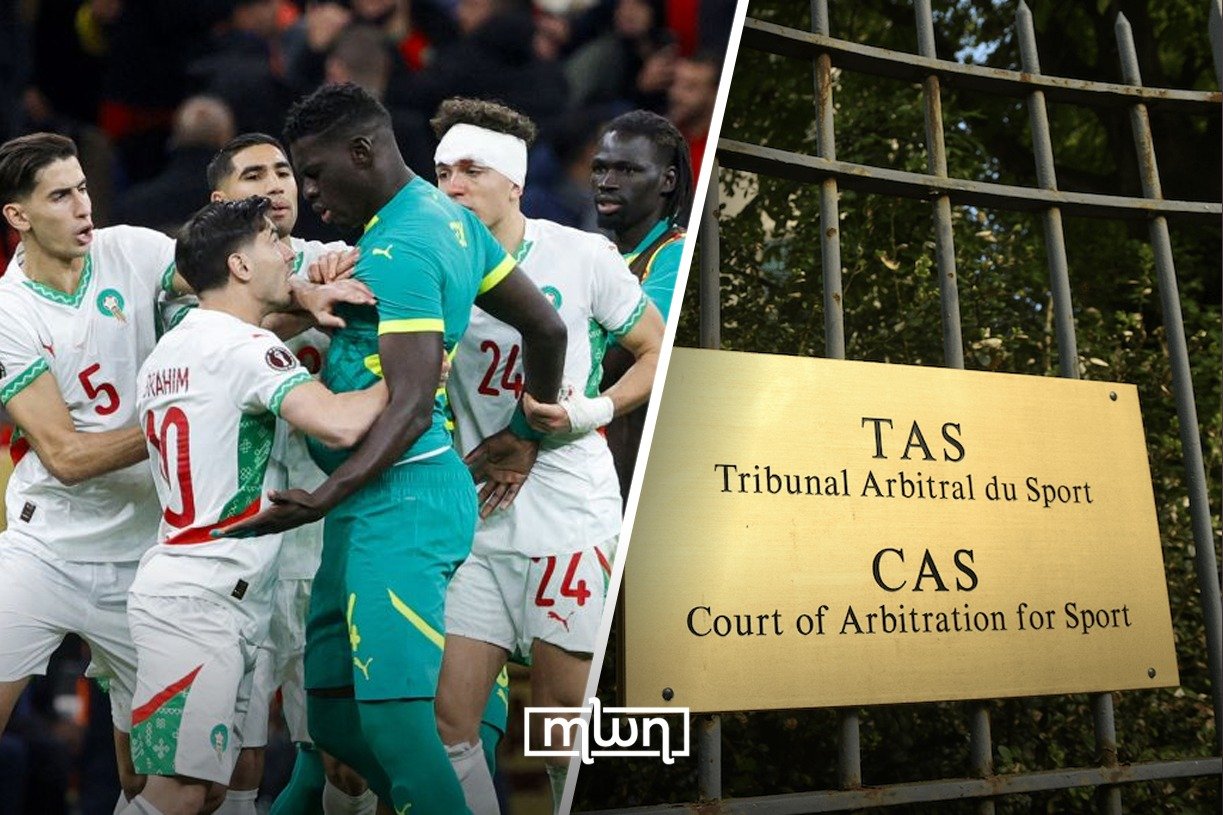
Rabat—The 2025 AFCON final between Senegal and Morocco ended in absolute sporting drama, leaving behind a lingering legal controversy that is still tearing opinion across African football.
On January 29, the Confederation of African Football (CAF) made public its disciplinary decisions stemming from the chaotic AFCON final, issuing fines and suspensions to both Senegal and Morocco and formally rejecting Morocco’s protest against Senegal’s temporary withdrawal from the final game that cost Morocco its second continental trophy.
Rather than closing the chapter, those rulings have triggered strong backlash in Morocco, where, for many fans and observers, the situation feels unfair and unresolved.
The legal battle revives memories of 2015, when the Royal Moroccan Football Federation (FRMF) successfully overturned sweeping CAF sanctions at the Court of Arbitration for Sport (CAS), a case that remains one of the most significant legal precedents in African football governance. CAS, based in Lausanne, Switzerland, is the highest independent legal authority for resolving disputes between sports federations, clubs, and governing bodies.
Now, Moroccans ask a familiar question: should the FRMF once again consider the CAS?
The 2015 CAS case
The AFCON 2015 case remains one of the most important legal precedents in African football history. Morocco, which was officially hosting the tournament that year, asked to push the tournament back because of the deadly Ebola epidemic in West Africa. A straightforward request, but harsh response:CAF came back with sweeping sanctions: banning them from the 2017 and 2019 tournaments entirely, plus hitting them with fines and damages totaling over $10 million.
The FRMF appealed to CAS in Lausanne, arguing that CAF’s punishment had no clear regulatory basis. Morocco’s legal case rested on three pillars:
- Force majeure (both parties are free from liability) citing a public-health emergency beyond sporting control
- Proportionality, arguing that the sanctions were excessive and unjustified
- Public-interest protections, referencing World Health Organization guidance on states’ responsibility during health crises.
In April 2015, CAS ruled decisively in Morocco’s favor. The sporting ban was annulled, the fine was reduced to $50,000, and CAF’s claim for damages was set aside. The ruling forced CAF to comply and restored Morocco’s place in continental competition, confirming CAS as a powerful check on CAF’s authority.
AFCON 2025: a different dispute but with familiar questions
Ten years later, Morocco once again finds itself on the wrong side of a controversial AFCON conclusion.
Following the chaotic AFCON 2025 final against Senegal, CAF’s Disciplinary Board imposed sanctions on both federations. These include:
- Senegal: The Senegalese Football Federation (FSF) was fined around $615,000, including penalties for fans’ misconduct and unsporting conduct by players and staff; Senegal’s coach Pape Bouna Thiaw received a five-match suspension. Key players such as Iliman Ndiaye and Ismaila Sarr were also banned for two matches each.
- Morocco: The FRMF was fined roughly $315,000 for incidents involving ball boys, obstruction of refereeing processes, and fan behaviour. Moroccan players, captain Achraf Hakimi and Ismaël Saibari, also received two-match suspensions and fines.
CAF also rejected Morocco’s formal protest seeking to have Senegal stripped of the trophy, ruling that it did not meet the competition’s regulatory requirements.
Why Morocco could refer the case to CAS a second time
Unlike the 2015 Ebola case, the current dispute is rooted in match governance, officiating, and disciplinary enforcement, rather than external force majeure. However, legal experts note that CAS jurisdiction is not limited to exceptional circumstances; it also extends to cases involving:
- Procedural fairness
- Regulatory interpretation
- Consistency and proportionality of sanctions
- Due process in disciplinary decisions
Back in 2015, the CAS essentially ruled that CAF had overstepped its boundaries and abused its power. If Morocco decides to pursue arbitration again now, the legal argument likely won’t focus on the on-field decisions themselves, but rather on whether CAF’s handling of the protests, disciplinary measures, and sanctions actually followed its own rules and international sports law standards.
If the FRMF were to consider taking its dispute to the CAS, part of the backdrop to that decision is CAF’s own regulation, specifically Articles 82 and 84 of the AFCON Regulations, which Morocco cited in its protest after the final. Those articles state that if a team “refuses to play, withdraws, or leaves the pitch without the referee’s authorization,” it’s deemed to have forfeited the match and can face elimination, a 3–0 loss by forfeit and additional sanctions at CAF’s discretion.
Morocco argued that Senegal’s brief walk-off fell under these provisions, but CAF rejected the protest, ruling that the circumstances did not meet the criteria to overturn the result or trigger the automatic forfeiture outlined in those regulations, leaving many in Morocco questioning whether the disciplinary process was applied consistently and reinforcing why an appeal to CAS remains part of the conversation.
If the FRMF chooses to challenge the CAF’s disciplinary decisions after the AFCON 2025 final, they’ll need to follow a very specific legal path.
The process begins by exhausting all internal CAF options. This means Morocco must first appeal the sanctions (fines, suspensions, etc.) to the CAF Appeal Board.
Only after that board issues its final internal ruling can the case be escalated to the CAS.
At that stage, the FRMF gets 21 days to formally file its appeal with the CAS Court Office in Lausanne, along with a 1,000 Swiss franc filing fee.
Next, an arbitration panel is formed: Morocco and the CAF each pick one arbitrator, and the CAS appoints a third, presiding arbitrator.
The case proceeds via written submissions, Morocco’s detailed appeal brief, followed by the CAF’s formal response, before an actual hearing takes place.
Finally, the CAS issues a final and binding arbitral award. While this process usually takes several months, it can be expedited in urgent cases.
As of right now, there’s no official confirmation that the FRMF plans to appeal the AFCON 2025 final to the CAS. However, given Morocco’s winning history at the arbitration court, that option remains a huge part of the ongoing legal discussion.
The 2015 ruling proved that CAF decisions aren’t immune to outside scrutiny. Whether that precedent gets invoked again all depends on if the FRMF views the current outcome as just a sporting disappointment or a fundamental legal principle worth fighting for.
