


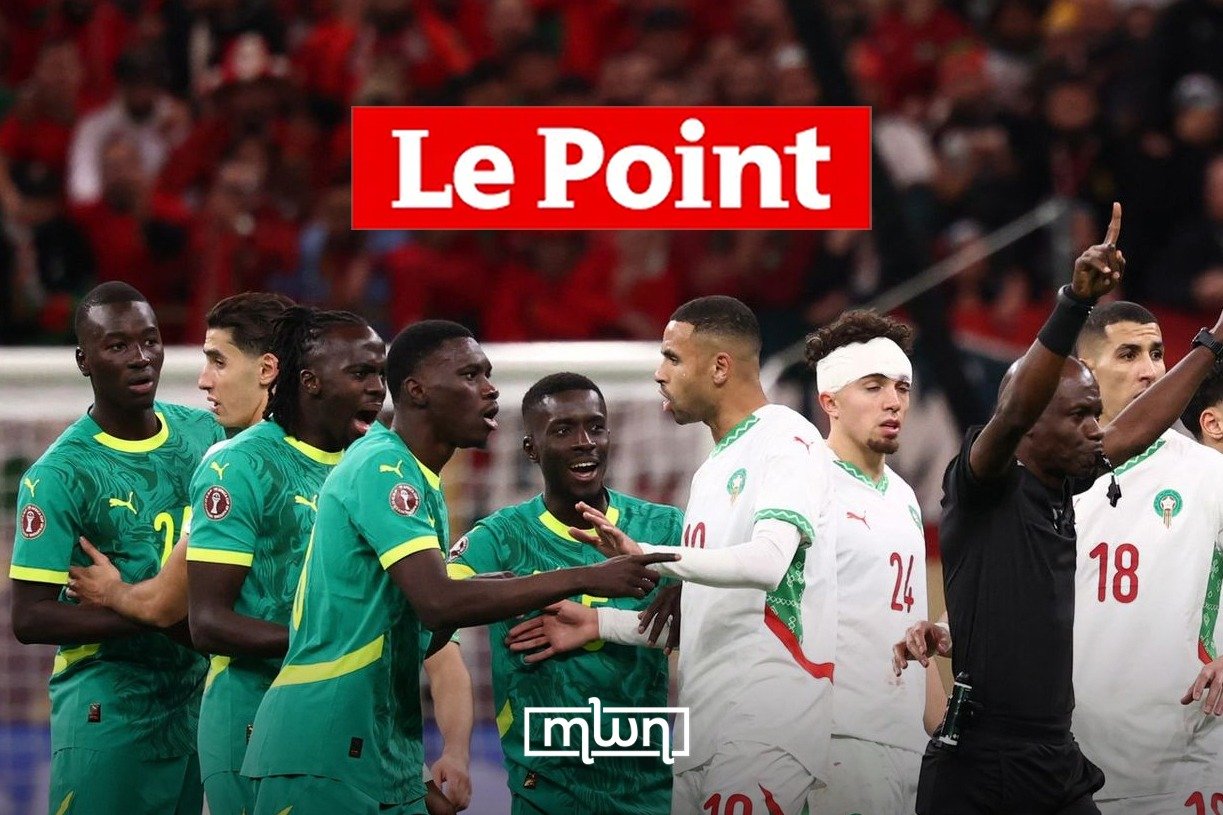
Rabat – Morocco’s General Directorate of National Security (DGSN) has issued a strong condemnation of a recent article by the French weekly Le Point, which falsely claimed that businesses owned by Sub-Saharan Africans were attacked or set ablaze following the Africa Cup of Nations (AFCON) final.
Described by the DGSN as baseless and misleading, the publication reflects a troubling pattern of misrepresentation by certain foreign media outlets during and after high-profile African events.
In its statement, the DGSN emphasized that no criminal incidents targeting Sub-Saharan businesses occurred anywhere in Morocco during or after the AFCON final.
“These allegations are entirely fabricated and contradict the reality on the ground,” the authority noted. Beyond a mere correction of facts, this raises a fundamental question: why would a media outlet of international reputation circulate such unverified and inflammatory claims?
Through its fact-checking, DGSN proved that throughout the tournament, Moroccan authorities actively monitored digital platforms to identify and debunk false information, issuing official statements to clarify the situation.
Yet, these verified sources were apparently ignored by Le Point, among other media outlets, which chose to prioritize sensationalism over accuracy.
A pattern of smear campaigns
This incident is not isolated. French, Senegalese, and Algerian media, as well as some Egyptian content creators and influencers, have all repeatedly portrayed Morocco in a negative light during and after this year’s AFCON tournament.
Their reports often focus on alleged violence, social unrest, or xenophobic attacks, claims that are frequently exaggerated, distorted, or entirely fabricated.
Even during the tournament, Morocco faced an intense wave of criticism, both from international observers and on social media. Some commentators went so far as to claim the games were rigged, while others openly questioned the organization of the event, targeting Moroccan authorities and the national team’s management.
This scrutiny extended across platforms and borders, with tweets, posts, and articles amplifying doubts, often ignoring the meticulous planning and professionalism that underpinned the tournament.
King Mohammed VI, alongside citizens across Morocco and observers from other countries, celebrated the AFCON tournament as a resounding success.
Fans and officials alike praised the organization, the spirit of the games, and the hospitality extended throughout the country, a reality that sharply contradicts the false narratives propagated by the media smear campaigns.
Even after the heated final against Senegal, Morocco remained composed, with authorities and fans alike adhering strictly to the law and public order. The country’s measured response and exemplary conduct stood in stark contrast to the chaos and unrest repeatedly depicted by foreign outlets.
Ethical responsibility and the politics of representation
The DGSN’s statement speaks of Morocco’s transparency and the readiness of its authorities to provide verified, factual information to any media inquiry.
Yet, certain French, Senegalese, Algerian outlets, and some Egyptian influencers bypassed these official channels, instead circulating allegations that were unverified, misleading, and sensationalized.
This is a textbook case of “negative framing”: events are selectively presented to construct a narrative of disorder, chaos, or threat, regardless of empirical reality.
One must ask: why target Morocco with such distortions when the nation demonstrated composure, civic responsibility, and respect for the CAF regulations throughout AFCON?
Moreover, late Wednesday night, large numbers of Moroccan supporters converged on Paris’s Champs-Élysées to celebrate Morocco’s qualification for the AFCON final, despite a prior ban on public gatherings linked to the match.
French authorities responded with a significant security deployment, mobilizing mobile gendarmerie units and motorcycle patrols around key areas, particularly near the Arc de Triomphe.
Police intervened to disperse the crowds, using crowd-control measures that included tear gas. While isolated tensions were reported between a small number of supporters and security forces, no serious incidents occurred, according to official accounts. By the early hours of the morning, calm largely returned to the avenue, although traffic disruptions persisted around Place de l’Étoile.
Yet, such scenes, documented by French outlets, did not prompt the same alarmist narratives later directed at Morocco. This contrast raises a legitimate question: why did Le Point turn a blind eye to events on French soil while amplifying unfounded claims about chaos in Morocco?
If public gatherings followed by police intervention in Paris are reported with nuance and restraint, why does similar, or even calmer, conduct in Morocco become the basis for sweeping allegations of violence and disorder? The selective framing suggests not a commitment to factual consistency, but a troubling double standard in how events are interpreted, depending on where they occur and whom they concern.
Losing a final, even a tense match against Senegal, does not diminish Moroccan pride, nor does it alter the country’s deeply held social and cultural values. Moroccans maintained order, celebrated responsibly, and upheld hospitality toward all residents and visitors, even under intense international scrutiny.
Critical theory also reminds us that media are not neutral conveyors of fact but instruments of power and perception. By propagating false narratives of unrest and xenophobia, these outlets perform a symbolic violence, shaping international perception of Morocco and, by extension, North and West Africa, as inherently chaotic.
This persistent misrepresentation erodes trust in journalism, fuels xenophobic imaginaries, and obscures the lived realities of those societies.
In the end, Morocco’s response embodies a fundamental truth that these smear campaigns cannot obscure: a nation can host a major international event, confront disappointment, and yet remain dignified, lawful, and consistent with its ethical and cultural values.
The question remains: why does the media choose distortion over reality, and why is Morocco repeatedly subjected to narratives that conflict so starkly with observable fact?
A call for accountability, fact-based reporting
The DGSN’s rebuttal shows a pressing need for responsible, accurate, and ethical journalism. Established media outlets are trusted and recognized precisely because they are expected to verify facts, provide context, and report with integrity.
Yet, this standard was repeatedly disregarded in most media outlets’ coverage of Morocco during AFCON. By publishing unverified claims of violence, unrest, or disorder, some outlets chose sensationalism over accuracy, undermining the credibility that comes with their reputation.
Morocco’s experience demonstrates the stark contrast between fact-based reporting and coordinated smear campaigns with international reach. Even as the country successfully hosted a major continental tournament, maintained public order, and ensured the safety and dignity of residents and visitors alike, narratives emerged portraying Morocco as chaotic or hostile.
This raises an uncomfortable question: is there an underlying agenda behind these persistent misrepresentations, a motive that extends beyond ordinary reporting errors to actively shape perception on the global stage?
Authorities reminded that official channels are always open to media inquiries, offering access to verified information and clarification. The repeated bypassing of these channels reflects a troubling prioritization of narrative over truth, of spectacle over reality.
In an era where misinformation can rapidly escalate into xenophobia, misunderstanding, or diplomatic tension, media outlets, especially those long-established, bear a moral and professional obligation to uphold accuracy, fairness, and accountability.
Morocco’s stand: facts over fiction
By issuing this statement, among many other statements, the DGSN reaffirmed Morocco’s commitment to public safety, transparency, and the fight against misinformation.
The episode also serves as a warning to international media: the pursuit of sensational stories cannot override the obligation to verify facts and respect the dignity of the communities being covered.
In the end, Morocco insists that accuracy, accountability, and ethical standards must define reporting.
