


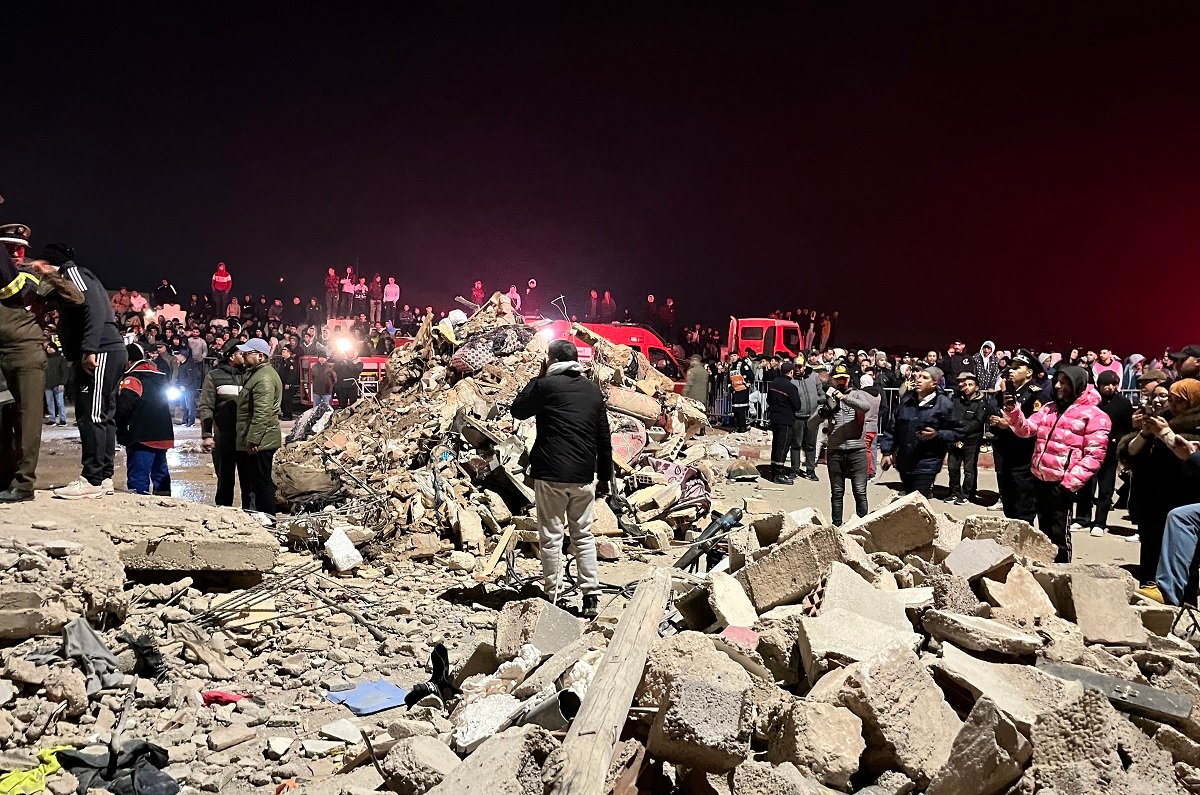
Marrakech – The National Council for Human Rights (CNDH) has demanded urgent action to guarantee adequate housing rights following the collapse of two residential buildings in Fez that killed 22 people and injured 16 others.
The buildings collapsed in the Al Massira district’s Al Moustakbal neighborhood between Tuesday night and Wednesday morning. Local authorities confirmed the final death toll after search and debris removal operations concluded.
The CNDH expressed “deep concern” over the tragedy and extended condolences to families who lost loved ones. The council’s regional human rights committee has begun investigating the incident’s circumstances and consequences.
According to preliminary data, the collapsed buildings were constructed in 2006 as part of self-construction operations for residents of the “Ain Smen” douar under the “Fez, city without slums” program. One building was empty during the collapse around 11:20 p.m., while the other was hosting a baptism ceremony.
The CNDH declared that adequate housing is a fundamental human right guaranteed by the International Covenant on Economic, Social and Cultural Rights, particularly Article 11, and enshrined in Morocco’s constitution under Articles 31 and 34.
The council referenced the UN Committee on Economic, Social and Cultural Rights’ General Comment No. 4, which defines adequate housing as including “structural safety, protection from hazards, building quality, access to basic services, security of tenure, and appropriate location to preserve human dignity.”
Administrative and judicial investigations are underway under the prosecutor’s supervision. Technical expertise has been assigned to specialized study offices to collect data related to the incident, identify technical causes, and determine procedural failures that may have affected legal procedures and regulatory standards in urban planning and construction.
CNDH warns of systemic failures endangering citizens
The CNDH warned that “repeated building collapse incidents directly violate adequate housing rights as defined by international standards.” The council advocated for adopting a comprehensive national strategy based on prevention, regular monitoring, and developing tracking and prediction mechanisms.
The organization insisted on publication of judicial investigation results with accountability measures to uphold “the principle of responsibility and accountability.” It also urged strengthening institutional coordination between relevant government sectors, territorial administration, and elected councils.
The CNDH stressed accelerating rehabilitation programs for deteriorated neighborhoods and buildings, particularly in old cities and historical areas. The council demanded “strict application of urban planning laws and related building regulations, especially mandatory building permits linked to rigorous technical control and quality engineering design.”
The statement proposed establishing a permanent joint rapid intervention mechanism to address detected cracks or structural defects, allowing preventive intervention before accidents occur “to protect lives and ensure urban security.”
Local authorities, civil protection, and security forces were alerted shortly before midnight following the collapse of the buildings housing eight families. They secured the perimeter, evacuated neighboring residents, and launched search operations. The 16 injured were transferred to the city’s university hospital.
The CNDH also encouraged citizens to cooperate positively with authorities’ guidance, particularly regarding evacuating buildings at risk of collapse, reporting any cracks or indicators threatening building safety, and participating in rehousing programs.
The council renewed its appeal for adopting “a sustainable public policy for rehousing families living in buildings threatened with collapse, providing adequate and integrated housing alternatives based on a social approach founded on dignity, fairness, and territorial justice,” not limited to temporary solutions.
