


A national investment in athletics and youth within Morocco combined with a global reorientation in world football has delivered a world class AFCON.
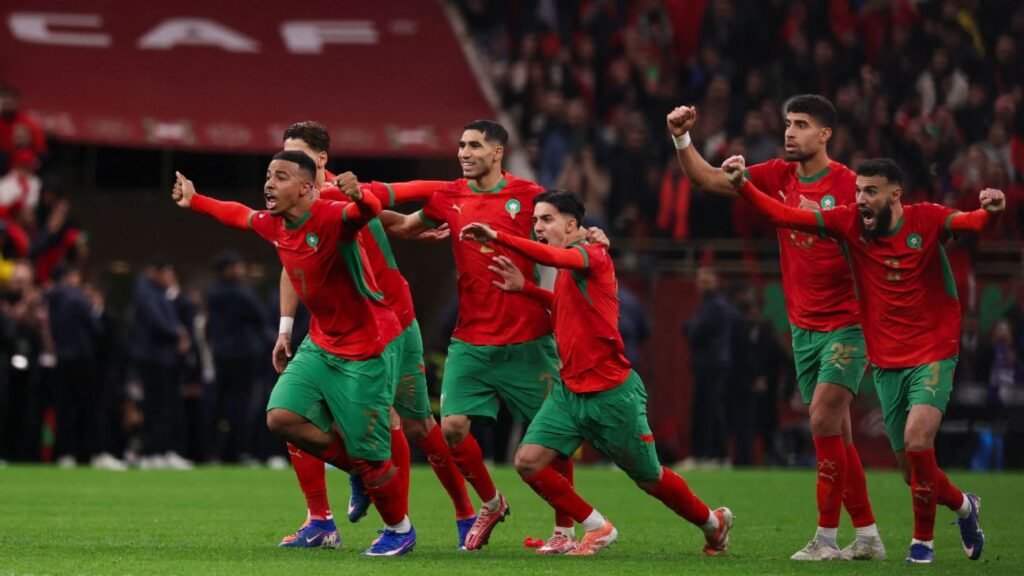
Like many classic sporting matches, extra time was needed. Morocco and Nigeria made their respective nations wait, as well as countless global fans of the beautiful game. The match went to penalty kicks, where legends are often made.
The Atlas Lions’ 4-2 semifinal victory over Nigeria now sets up a championship showdown Sunday with rival powerhouse Senegal, who beat Egypt 1-0 in the other semifinal. The matchup has all the makings for a classic. The two teams are the highest ranked African squads in the current FIFA world rankings — Morocco at 11 and Senegal at 19.
There are many dramatic storylines that will unfold before Sunday’s match.
Top Talent
Among the two squads that are filled with talent, Senegal’s swift left winger, Sadio Mané, who now plays for Saudi Pro League club Al-Nassr, will meet Moroccan icon, CAF 2025 Player of the Year, and Paris Saint-Germain defender Achraf Hakimi.
AFCON 2025 has also demonstrated the maturation and importance of football on the continent. Africa is now more than just a football talent training ground; it is a designation in itself. There were nearly three dozen Premier League players on AFCON 2025 squads, as well as dozens more from La Liga, Ligue 1, the Saudi Pro League. Importantly, Morocco’s Botola Pro, and other leagues inside the continent of Africa, provide high-end playing opportunities for new and established players.
Prior to the beginning of AFCON in December, the Confederation of African Football (CAF) made two big announcements. First, AFCON will take place every four years instead of every two years. Second, the launch of a new competition structure: the African Nations League, which would emulate the UEFA version in Europe and take place every year. The new structure is an acknowledgment of the abundance of talent and infrastructure on the continent and the crowded international football schedule for many players.
One measure of the depth of talent in Morocco and, indeed, Africa is the attention given to up and coming players like Othmane Maamma. The young Moroccan is attracting significant transfer attention from clubs like Liverpool and Manchester United. Senegal’s Lamine Camara is a future global superstar, too.
Last fall, FIFA President Gianni Infantino announced that over $1 billion has been invested in African football since 2016, primarily through the FIFA Forward program. The FIFA leader has spoken often of the quality and depth of Africa’s talent and national training programs. Last year’s top two Ballon d’Or finalists, Lamine Yamal and winner Ousmane Dembélé, have strong family ties to Africa.
1976
As it prepares to play its first AFCON final since 2004, Morocco will now aim to win their second continental title, their first one since 1976.
And much has changed in Morocco and in African continental soccer in the intervening five decades.
When Morocco won the AFCON championship in March 1976, the match was played at the Addis Ababa Stadium in Ethiopia before a crowd of 30,000 fans, less than half the attendance for this year’s semifinal (65,000) held in Rabat. Sleek in design, the Prince Moulay Abdellah Stadium represents an investment in sporting excellence that will be featured again at other premier FIFA tournaments, including in 2030 when Morocco co-hosts the FIFA World Cup with Spain and Portugal.
The AFCON hosting experience, from crowd flow to transportation to lodging to media relations, will serve Morocco (and other future hosts) well.
There was a bit less drama at AFCON 1976: The AFCON winner was determined by a final group stage, a round-robin format amongst the final four teams. The key Guinea-Morocco match ended in a 1−1 draw, good enough for the Atlas Lions to keep first place in the final stage and win the tournament.
Morocco was quite different in 1976, too. The nation’s population was 17 million, less than half of today’s 38 million. In the 1970s, less than half of Moroccan children attended primary school. Today, that figure is over ninety-eight percent. Today, Morocco’s GDP ($179 billion) is eighteen times larger than it was in 1976. Tourism and textiles are now accompanied by aerospace manufacturing and financial services.
Development challenges remain (as they do elsewhere) but the experience of hosting football talent from across the continent is symbolic of the considerable progress made in both human development and physical infrastructure.
Morocco’s location and hospitality has made AFCON 2025 a benchmark. Whether the final match between Morocco and Senegal becomes a classic or not, the entire continent can take a bow for creating so much sporting talent. Moroccans can take pride, too, in their performance on and off the pitch.