


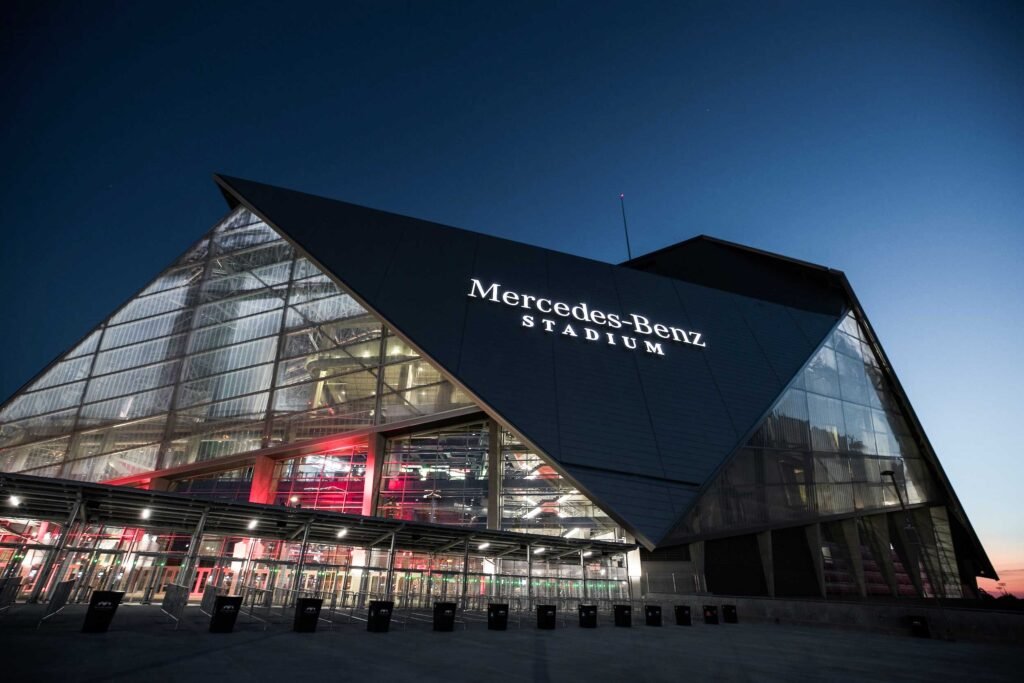
Rabat—In an exclusive virtual briefing with Morocco World News (MWN), the Atlanta World Cup Host Committee detailed its operational plans, stadium enhancements, fan engagement initiatives, and long-term legacy goals as the United States prepares to co-host the first-ever 48-team FIFA World Cup.
The briefing featured senior officials including Dietmar Exler, Chief Operating Officer of AMB Sports and Entertainment; Dan Corso, President of the Atlanta World Cup Host Committee; and Adam Fullerton, Vice President of Stadium Operations at Mercedes-Benz Stadium.
Officials highlighted that preparations are now moving from planning to execution. Key elements include a FIFA-exclusive natural grass pitch, climate-controlled matchday conditions, and a free FIFA Fan Festival set to take place in downtown Atlanta.
Atlanta is once again preparing to welcome the world — this time as one of the premier host cities for the FIFA World Cup 2026™. During the virtual briefing, organizers outlined plans to deliver one of the tournament’s most ambitious and fan-centered experiences.
With major stadium upgrades underway, advanced pitch technology being installed, and a large-scale Fan Festival planned in the heart of the city, Atlanta is positioning itself as a central hub of the expanded global tournament.
A city shaped by football
Atlanta’s road to becoming a major football city has been an incredible journey, according to Dietmar Exler, who’s the COO for AMB Sports and Entertainment.
Exler, who is originally from Austria, remembers a time not that long ago — maybe fifty years back — when soccer was basically a non-entity here. You wouldn’t find a pro team, the facilities were minimal, and honestly, nobody really cared about the sport.
But everything shifted in 2014. That’s when they announced Atlanta United. The team hit the field in 2017, and it didn’t take long for them to explode in popularity, becoming one of Major League Soccer’s most successful and culturally significant clubs around.
“The fan culture in Atlanta is unmatched,” Exler said. “The team is deeply connected to the city.”
The city’s soccer obsession goes way deeper than the stadium. By planting over 50 mini-pitches right in the heart of local neighborhoods, they’ve made sure every kid has a chance to get on the ball. Combine that grassroots energy with the massive surge in women’s soccer, and you can see why Atlanta’s football foundation is stronger than ever.
Atlanta enters the 2026 World Cup with a proven track record. The city has hosted multiple Super Bowls, the opening match of the 2024 Copa América between Argentina and Canada, and six matches at last summer’s FIFA Club World Cup, events Exler described as valuable test runs.
Mercedes-Benz Stadium will host eight World Cup matches:
- Five group-stage games
- One Round of 32 match
- One Round of 16 match
- One semi-final
Among the teams set to play in Atlanta are Spain and Morocco, co-hosts of the 2030 World Cup. Exler also took the opportunity to wish Morocco success ahead of the upcoming AFCON finals.
Built on continuity, not temporary structures
Dan Corso, President of the Atlanta World Cup Host Committee, said the city’s approach is rooted in long-term collaboration rather than short-term planning.
“We work very closely together across organizations,” Corso said. “There’s continuity, the same people, the same teams, event after event.”
That continuity stretches back to Atlanta’s hosting of the 1996 Summer Olympics, making it one of only two US cities to have hosted both the Olympics and the FIFA World Cup.
The December draw was a total game-changer for the planning team. With the actual matchups and locations locked in, they’ve shifted from broad plans to the nitty-gritty details, tailoring the entire experience to fit the specific needs of the teams and the fans heading to the city.
Mercedes-Benz Stadium 🇺🇸
👤 Capacity – 42,500 (expandable to 71,000)
📍Location – Atlanta, Georgia. pic.twitter.com/Bsz2HVoXnS
— Jogo Bonito (@ufcfooty) April 21, 2023
A free Fan Festival at Olympic Park
One of Atlanta’s signature offerings will be its FIFA Fan Festival, set to take place at Centennial Olympic Park, a legacy venue from the 1996 Games located just steps from the stadium.
The Fan Festival will be:
- Free and open to the public
- Designed to bring energy back to downtown Atlanta
- Supported by optional premium VIP experiences
More details are expected later this spring.
At the same time, the Host Committee is holding meetings with international consulates to help shape cultural programming, ensuring visiting fans feel welcomed and represented.
Inside Mercedes-Benz Stadium: the biggest work still ahead
Adam Fullerton, Vice President of Stadium Operations at Mercedes-Benz Stadium, said the most demanding phase of preparation is still to come.
Starting January 31, they’re pulling up the old synthetic field at the stadium. The plan is to dig down and install a brand-new, natural grass pitch that’s specifically for FIFA events. This big upgrade includes a new vacuum system for air flow, a modern way to water the grass, and a tough hybrid surface that mixes real bluegrass with a synthetic element to keep everything stable and looking great
FIFA has assigned a dedicated pitch manager to oversee the process, applying lessons learned from previous tournaments and adapting the surface specifically for summer conditions.
“There’s a lot more science behind the grass than people realize,” Fullerton said.
Branding, hospitality, and sustainability
One of the more complex challenges will be the temporary removal or covering of all non-FIFA branding inside the stadium, including the iconic Mercedes-Benz emblem on the roof.
The leading solution currently involves a large-scale graphic laydown, though discussions with vendors are still ongoing.
VIP hospitality areas will also be upgraded, while two priorities will remain unchanged: customer service and sustainability, with the stadium aiming for zero waste during the tournament.
Heat, safety and fan comfort
With Atlanta’s hot summer climate in mind, organizers said heat management is part of every planning discussion.
Mercedes-Benz Stadium’s retractable roof and full climate control mean matches will be played in stable conditions, with temperatures expected to remain around 22–23°C, even for midday games. Outside the stadium, cooling units, shaded areas and water stations will be installed at gates and across key areas of the city.
Public safety coordination is ongoing, with heat mitigation addressed at every operational level.
A welcoming city in the midst if an unwelcoming country
Organizers keep talking about how Atlanta is a truly global, welcoming and inclusive city. They genuinely believe it has that special something that makes it perfect for hosting the world’s biggest soccer tournament.
“Welcoming the world is part of Atlanta’s DNA,” said Dan Corso, pointing to the city’s role in the Civil Rights Movement and its diverse population as proof that international visitors will feel safe and embraced.
Visas: the biggest obstacle
Are fans even welcome at America’s door?
That idea of Atlanta being a totally open, global city is unfortunately running into some serious headwinds with the US immigration policies reality right now.
The Trump administration has just implemented new restrictions that are creating a massive amount of stress and uncertainty for fans who want to travel to America for the 2026 World Cup. This situation heavily impacts people from countries across Africa, the Middle East, Asia, and Latin America, regions that will be very strongly represented at the tournament.
For instance, fans from qualified countries like Haiti and Iran are essentially banned from going at all unless they get a very rare special exemption.
Meanwhile, a much broader group of qualified nations, including major football powerhouses – including Morocco – like Brazil, Colombia, Uruguay, Senegal, Egypt, Ghana, and others, face significant hurdles. All of these countries will face a total immigration visa freeze starting January 21, which could mean compounded stress on the only option available – tourist visas. Even that, for some countries, including Algeria, the US will require a $15,000 security bond in order to obtain the short-term visa.
Even with FIFA trying to help fans out with a special “FIFA PASS” system for priority appointments, many critics are convinced that these harsh policies will just end up scaring thousands of passionate fans away from making the trip to cheer for their teams. To make matters worse, increasing reports of ICE officers shooting people in the streets and kidnapping citizens whom they profile as irregular migrants make the situation even that much more perilous for some fans.
Football, after all, is nothing without its people, and for many fans from affected nations, the question is no longer just about tickets or accommodation, but whether they will feel safe, welcome, or even want to enter the country.
Despite those concerns, Atlanta organizers remain confident.
“The city remains confident in its ability to host all qualified teams and their supporters,” Corso said.
Confidence also extends to attendance inside the stadium. Organizers expect demand to be overwhelming.
“We’re very confident the matches will sell out,” said Dietmar Exler. “Atlanta is the epicenter of soccer in the U.S.”
The core challenge for Atlanta now is making sure its open invitation can survive the messy global political climate surrounding the World Cup. They have to ensure that fans everywhere genuinely feel welcome, not just told they are.
Defining success in for the 2026 World Cup
For Atlanta, success will go beyond attendance figures.
The goal is for fans to leave believing they have experienced:
- One of the best venues they have ever visited
- One of the best fan experiences of their lives
- A premium playing surface that players trust
The countdown to the 2026 tournament is on, and Atlanta is preparing for a defining moment. They intend to use this World Cup as their big stage to show the entire world what the city is all about.