


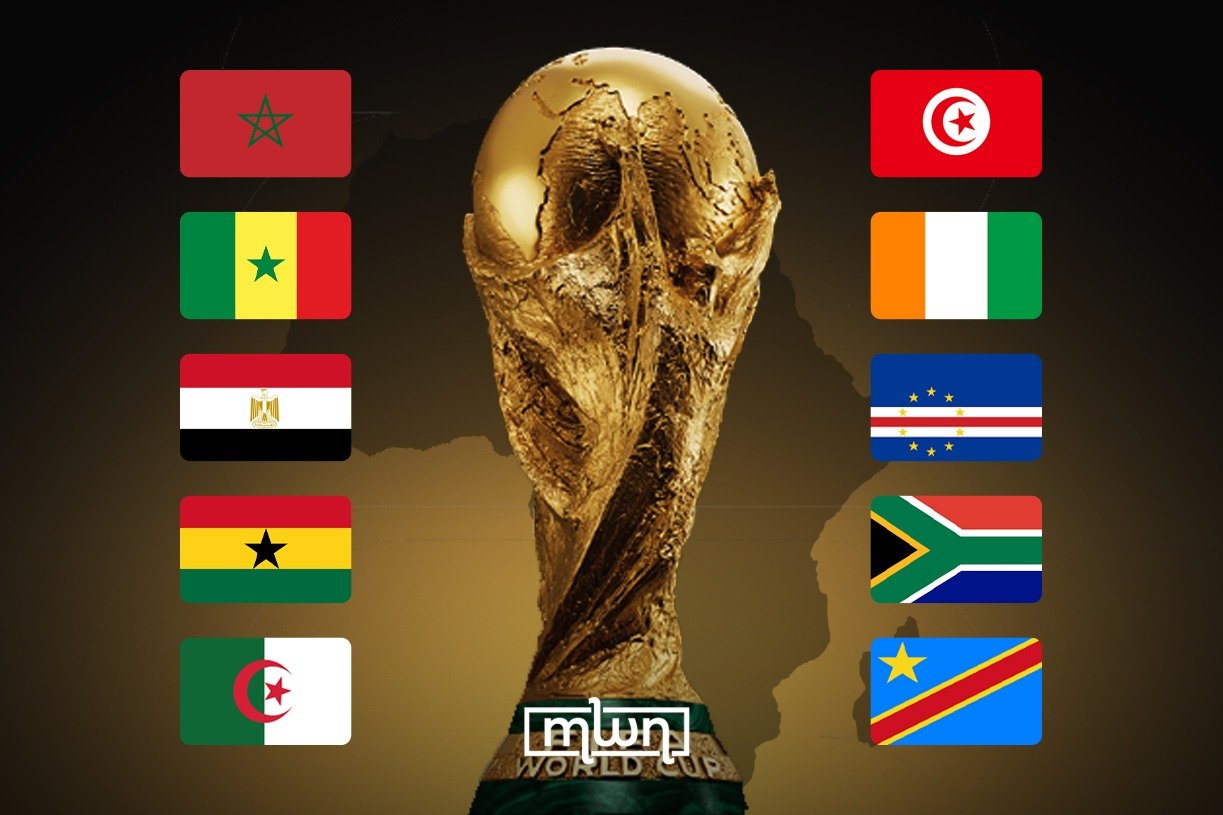
The Democratic Republic of Congo (DR Congo) secured its place as the 10th African country in the World Cup 2026 after defeating Jamaica by 1-0 in an intercontinental play-off on March 3, with Axel Tuanzebe scoring in extra time. The Leopards will participate in the World Cup finals for the first time in 52 years since 1974.
The 10 African countries qualified for the 2026 World Cup:
1-Morocco (MAR)
2-Senegal (SEN)
3-Egypt (EGY)
4-Ghana (GHA)
5-Algeria (ALG)
6-Tunisia (TUN)
7-Côte d’Ivoire (CIV)
8-Cape Verde (CPV)
9-South Africa (RSA)
10-DR Congo (DRC)
Groups of the African qualifiers for 2026:
Morocco (MAR) — Group C
- Group C: Brazil, Morocco, Scotland, Haiti
Senegal (SEN) — Group I
- Group I: France, Senegal, Norway, Iraq
Egypt (EGY) — Group G
- Group G: Belgium, Egypt, Iran, New Zealand
Ghana (GHA) — Group L
- Group L: England, Croatia, Ghana, Panama
Algeria (ALG) — Group J
- Group J: Argentina, Algeria, Austria, Jordan
Tunisia (TUN) — Group F
- Group F: Netherlands, Japan, Tunisia, Sweden
Côte d’Ivoire (CIV) — Group E
- Group E: Germany, Ivory Coast, Ecuador, Curaçao
South Africa (RSA) — Group A
- Group A: Mexico, South Africa, South Korea, Czechia
DR Congo (COD) — Group K
- Group K: Portugal, DR Congo, Colombia, Uzbekistan
Cape Verde (CPV) — Group H
- Group H: Spain, Uruguay, Saudi Arabia, Cape Verde
History of the 10 African teams at the World Cup:
1 – Morocco (MAR):
Morocco has established itself as arguably the most successful African nation in World Cup history. While they first made waves in 1986 by becoming the first African team to top a group and reach the knockout stage, their crowning achievement came at the 2022 World Cup in Qatar. During that tournament, the Atlas Lions captured the world’s attention by defeating giants like Spain and Portugal to become the first African and Arab country to ever reach a World Cup semifinal.
2 – Senegal (SEN):
Senegal’s World Cup history began with one of the greatest upsets in sports history when they defeated defending champions France in the opening match of the 2002 tournament. That remarkable debut run carried them all the way to the quarter-finals, a feat that solidified their reputation for tactical discipline and physical power. Although they faced a heartbreaking exit in 2018 due to “fair play” points (yellow cards), Senegal bounced back in 2022 by reaching the Round of 16, proving they remain one of the most consistent contenders from the continent.
3– Egypt (EGY):
Egypt holds the distinction of being the first African and Arab nation to ever participate in a World Cup, dating back to 1934. Despite their massive success in continental competitions—holding a record seven Africa Cup of Nations (AFCON) titles—their World Cup history is defined by long absences and a struggle to find a win. Their most recent appearance in 2018 was highlighted by the presence of international player Mohamed Salah, though they have yet to record a victory in the finals across their three tournament appearances.
4-Ghana (GHA):
The “Black Stars” of Ghana have provided some of the most dramatic moments in recent World Cup history. Making a splash in their 2006 debut by reaching the Round of 16, they went even further in 2010, coming within a single penalty kick of the semifinals. That match against Uruguay remains one of the tournament’s most controversial and famous exits. Known for producing world-class midfielders and playing with high energy, Ghana has qualified for four of the last five tournaments, missing only 2018.
5-Algeria (ALG):
Algeria’s World Cup journey is defined by resilience and technical flair. In 1982, they pulled off a historic 2–1 victory over West Germany, only to be eliminated by a controversial “arranged” match between Germany and Austria. Decades later, at the 2014 World Cup, the “Fennec Foxes” reached the Round of 16 for the first time and pushed eventual champions Germany to the absolute limit in a 2–1 extra-time thriller, a performance widely regarded as one of the best by an African team in the knockout stages.
6-Tunisia (TUN):
Tunisia has been a consistent representative for Africa, appearing in six different World Cups. They made history in 1978 by becoming the first African team to ever win a World Cup match, a 3–1 victory over Mexico that paved the way for Africa to receive more qualifying slots. While Tunisia has yet to progress past the group stage, they have earned a reputation for being a “tough out” for European giants, most notably defeating the defending champions France 1–0 in the 2022 edition.
7- Ivory Coast (CIV):
Often hailed as the best African team to never reach the knockout rounds, Ivory Coast’s history is one of immense talent hampered by terrible luck. During their “Golden Generation” led by Didier Drogba, the “Elephants” qualified for three consecutive tournaments (2006, 2010, 2014) but were placed in the “Group of Death” nearly every time, facing giants like Argentina, Brazil, and the Netherlands. Despite playing attractive, attacking football, they narrowly missed out on the Round of 16 in all three attempts.
8-Cape Verde (CPV):
Cape Verde is the latest success story in African football, having officially qualified for their first-ever FIFA World Cup in late 2025 for the 2026 tournament. As one of the smallest nations by land area and population to ever reach the finals, the “Blue Sharks” have made a remarkable rise from being relative obscurity to a major continental force. Their qualification reflects their incredible scouting of their diaspora and a highly organized domestic football structure.
9-South Africa (RSA):
South Africa’s World Cup history is closely tied to their role as the first African nation to host the tournament in 2010. While the country participated in 1998 and 2002, the 2010 edition remains its most iconic moment, highlighted by Siphiwe Tshabalala’s opening goal against Mexico, which ignited celebrations across the continent. Although they became the first host nation to exit in the group stage, their hosting of the event is remembered as a massive cultural and logistical success for African sport.
10-DR Congo (COD):
DR Congo made their sole World Cup appearance in 1974 under their former name, Zaire, becoming the first sub-Saharan African nation to qualify for the finals. Their tournament proved challenging, marred by internal disputes over player payments and threats from the country’s dictatorship. Despite their 9–0 loss to Yugoslavia, the team is immortalized in football history for the “Mwepu Ilunga” incident, when a defender famously charged out of the wall to kick a Brazilian free kick before it was taken—a moment of confusion that has since become a cult legend.
